


There's a reliable gap between what users tell you and what they do. Interviews and surveys capture the first. A UX research field study captures the second by watching people use a product where they normally use it.
The trade-off is cost.
A field study takes more planning and budget than a quick round of interviews, which is why the first decision is whether you need one at all. So this guide covers when a field study beats other methods, when it doesn't, and how to run one if it fits.
What is a UX research field study?
A UX research field study is a method where you observe people using a product in the place they normally use it. That might be their office, their home, a warehouse, a hospital ward, or even the front seat of a car. You watch what they actually do instead of what they remember doing later.
That difference does a lot of work.
Interviews and surveys give you the behavior people report about themselves, and those reports get shaped by memory, habit, and the wish to sound reasonable. People forget the workaround they built months ago because it now feels automatic. They skip the annoying step because they stopped noticing it.

Surveys and polls are only good for certain kinds of things, and writing good survey questions is not easy. I don’t think you can expect a single research method to be applicable to every project though and you should choose the method based on your research goals.

A field study catches those moments as they happen, together with the interruptions, the cluttered desk, and the small frustrations nobody thinks to bring up.
When field research is the right method (and when it isn't)
The fastest way to choose is to ask what kind of question you are stuck on. A field study answers questions about the problem. What are people trying to do, in what order, with which tools, and where does it break down? It does not answer questions about a design you have already drafted. That job belongs to a usability test.
This is the split between problem discovery and solution discovery.
A field study is a problem discovery method. You use it when you do not yet know enough to trust the solution you would build. A guerrilla or café study sits on the other side, where you validate assumptions and check whether an early design direction holds up with real people. One method tells you what to build. The other tells you whether what you built works.
People volunteer to participate ahead of time and they are usually paid for their time. They can involve a variety of methods like 1:1 interviews, observations, workflow walkthroughs, etc.
When a field study earns its cost
A field study earns that cost in a handful of situations where the environment itself is the thing you need to see.
- Early discovery. You are entering a new domain or target audience and need to understand how people work before you design anything.
- Product redesigns. The current product has problems you can measure but cannot explain, and you need to watch the workarounds users lean on.
- Complex workflows tied to the environment. People stitch together several systems, a phone call, and a paper form to finish one task, and that sequence only shows up when you watch it happen.
- Accessibility. You need to see how someone uses assistive technology in their own setup, not a borrowed one.
When a field study wastes it
A field study burns that same budget just as fast in the situations where a lighter method would hand you the same answer.
- Tight deadlines. Field studies run on patience and observation. If you need direction this week, a few user interviews will move faster.
- You need numbers. If you need quantitative data on how many users hit a problem, a survey or your analytics will serve you better.
- Refining a live product. If you’re polishing something that already works, a remote usability test or a guerrilla session gives cheaper answers.
- Sensitive settings. If the work involves confidential information you cannot observe, controlled lab research is the safer choice.
How field study compares to nearby methods
A few other UX research methods have come up already, and the line between them is easy to blur. In the table below, we set them side by side so you can see which question each one really answers.
Notice that only the field study starts from the problem. Every other method assumes you already know enough to ask about a design, an opinion, or a count.
That is why a field study is worth its higher cost at the moment you are least sure what to build, and a waste of budget once you already know.
The main types of field studies
Field study methods blur into one another, and a single study often borrows from several at once. What separates them is two things. The first is how involved you get, from quietly observing users to asking questions to doing the task. The second is how long you stay, from a single session to a few weeks of regular check-ins.
Keep those two dials in mind as you read. Picking a type is mostly a matter of setting them for the study in front of you.
Direct observation
Direct observation is exactly what it sounds like. You watch people work in their own setting and stay out of the way, taking notes without asking interview questions or steering the task. Nielsen Norman Group calls this the “fly on the wall” approach, where the researcher does not intervene in what the research subjects are doing.
The restraint is what makes it work. Staying quiet lets you see the real sequence of a task, and the workarounds nobody would think to mention in an interview.
This method works best for:
- Mapping how a real task flows, step by step, before you design for it.
- Settings where people cannot be interrupted or distracted.
- Catching the shortcuts people build without even noticing.
It is a weaker choice for narrow design questions, like whether a signup form is clear, where a usability test answers you faster. And watch for the observer effect, since people behave a little differently when they know someone is studying them. The reassuring part is that it tends to fade over time, even as the observation continues.
Shadowing and participant observation
These two methods add movement and, sometimes, your own hands. User shadowing research means following one person in their environment to understand how they carry out their everyday activities. You stay with them as they move from task to task, so you see the whole journey instead of a single moment.
Participant observation goes further. You take part in the activity yourself, performing tasks or asking the occasional question, without steering the UX research process.
The payoff is understanding you cannot get from a fixed spot. Moving with someone shows you the handoffs, the interruptions, and the small social exchanges that shape how the work really gets done.
These methods work best for:
- Following a role or a journey from start to finish.
- Understanding the social side of work.
- Feeling the friction firsthand by doing a piece of the task yourself.
Because you are closer to the action, the risk of nudging user behavior is higher, so keep your involvement light and let the person lead. It is also too time-consuming to run at scale, so treat what you find as a rich starting point.
Contextual inquiry
Contextual inquiry sits between watching and interviewing. You observe someone doing a task in their own setting, and you ask questions along the way to understand why they do what they do. It is a type of ethnographic field study UX research that combines in-depth observation with interviews of a small group of users.
The mix is what makes it powerful. Pure observation shows you what happens but leaves you guessing at the reasons. Contextual inquiry lets you catch a moment as it unfolds and ask about it before the person forgets the small decision they just made.
This method works best for:
- Understanding complex or knowledge-heavy work where the reasons behind each step matter as much as the step itself.
- Learning the mental models and vocabulary people use, straight from how they talk through their own tasks.
- Untangling workflows that span several tools, where you need to hear why someone jumps from one to the next.
Be aware that your questions can interrupt the very flow you are trying to study, so you time them carefully and let the person work whenever the task demands their full attention. It is a weaker fit for narrow, straightforward interfaces, like a signup form, where the added interview brings little that a quick usability test would not.
Diary studies
A diary study hands the recording over to the participant. You ask people to keep a log of their own experiences over days or weeks, noting what they do and how they feel while it is still fresh. What you get back is a record that builds up over time.
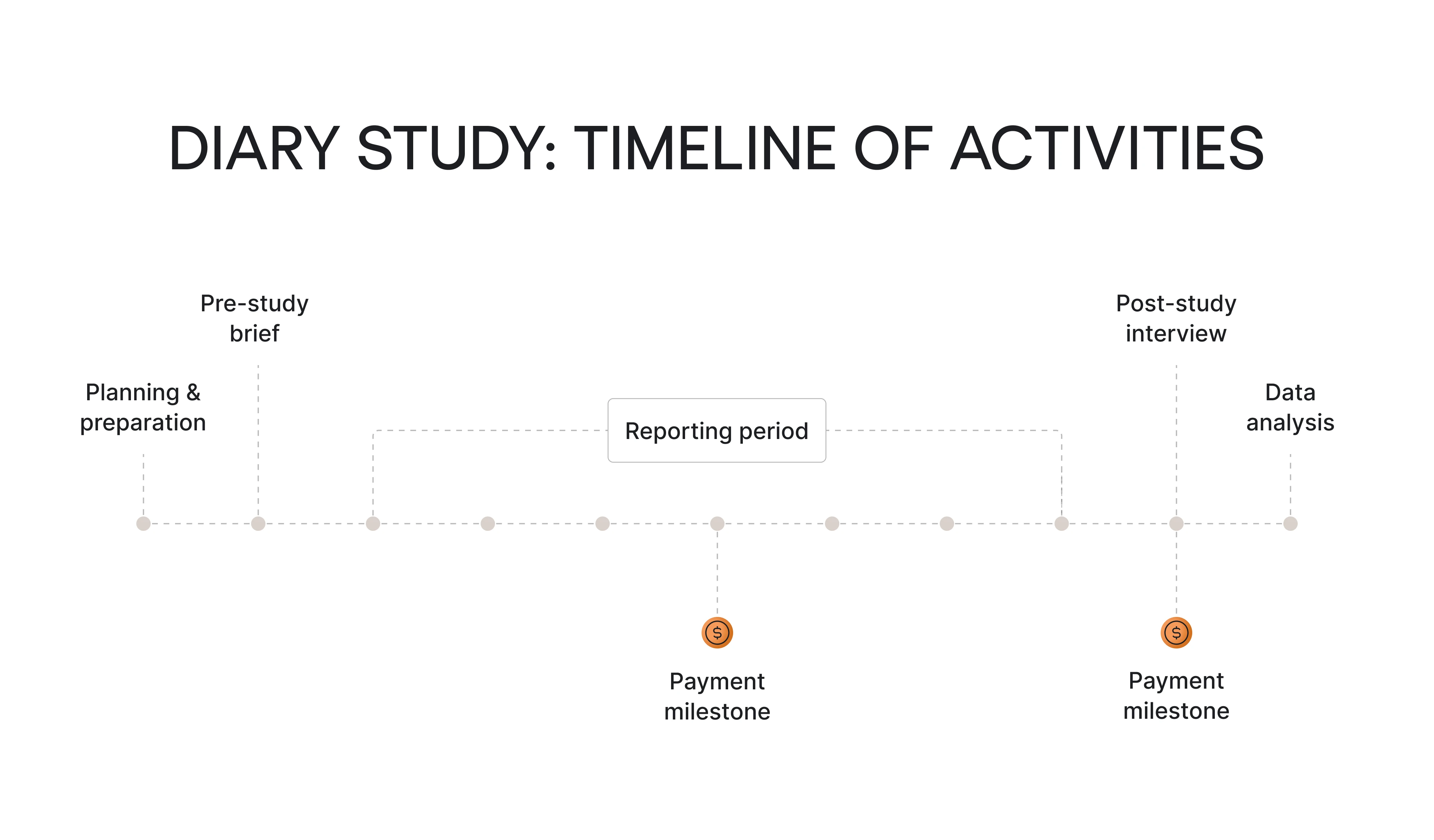
That stretch of time is the whole point. The methods so far all need you in the room. A diary study does not, so it runs remotely and lets you reach scattered users at a lower cost, while showing how something shifts from one day to the next.
This method works best for:
- Behavior that changes slowly, like how someone's view of a product moves after a week of real use.
- Activities that are repetitive, long, or hard to predict, where sitting and waiting to observe would be impractical.
- Reaching distributed users at the same time, without the cost of visiting each one.
Relying on this method means trusting people to log honestly and often, and that willingness fades. Fatigue sets in, entries get thin, and dropout eats into your sample. Be prepared that a few people might also write what they think you want to hear rather than what they really did.
You will always have to accept some level of mistakes in systems like this. 100% accuracy is simply not possible. 50% is absolutely terrible, though. 80% is pretty good.
Remote and mobile field studies
This is less a separate method than a way to run the others from a distance. The researcher and the participant are in different locations, yet the study still gathers the same kind of information as an in-person one.
The phone in someone's pocket does the capturing. People film short clips, snap photos, record their screen, or answer a prompt as something happens, so you see real behavior in a real setting. Platforms built for this, such as EthOS, let you assign those tasks and pull ethnographies, diary studies, and chat interviews into one place.
This method works best for:
- Reaching target users spread across places you could never visit in person.
- Catching brief moments as they happen.
- Moving fast on a small budget.
The catch is that you see only what the camera is pointed at, so you miss the wider context a researcher in the room would pick up. It works best as a way to stretch the other methods further, so pair it with a live conversation whenever the why matters.
Ethnographic research
Ethnography is the deepest and longest type. Instead of studying one task, you immerse yourself in a person's or a group's world for a sustained period, in some cases working alongside them or even living as one of the group. You do this to understand the habits, culture, and unwritten rules that shape what people do.
Sometimes doing ethnography really is the best way to get a full picture of people’s experiences.
The immersion is what sets it apart. A field study might catch a task. Ethnography catches the whole world around it, the social pressures and shortcuts that only surface once people forget you are there. That makes it powerful when your users live in a setting very different from your own, where you cannot guess at the norms.
This method works best for:
- Entering a domain or culture you know little about.
- Uncovering needs people cannot name.
- Big, strategic questions about what to build.
Full ethnography can run for weeks or months, which makes it the most time-consuming and expensive method of the set. In practice, most teams run a lighter version, using it on a short-term basis, and treat a few focused visits as enough to point them in the right direction.
Step-by-step guide to plan and run a field study
A field study rewards preparation more than most methods, because you usually get one shot in someone's environment and cannot rerun the moment if you show up unready. Before you step in, let's go through the 8 steps that get the process right.
Step 1: Start with the decision you need to make
Before anything else, ask what decision-making this user research will shape. Not “we want to understand our users,” but something like “should we rebuild the onboarding flow, or is the real drop-off happening after signup?”
A field study is expensive, so it earns its keep only when it answers a question someone is already waiting on.
From that decision, write 2-3 research questions. A good one is specific enough that you will know when you have reached an answer, and practical enough to answer inside a single study. Also, involve the people who need the answers, as they become more invested and far more likely to act on what you bring back.
Step 2: Design the study
Now turn that question into a research plan. First, pick the type from the six research methods above, driven by how deep you need to go and how involved you can be.
- If you mostly need to see a task run, direct observation is enough.
- If you need the reasoning behind each step, contextual inquiry fits.
- If the reasons are cultural, you are closer to ethnography.
Then set the scope. A field study is a qualitative method, so you are chasing insight, and a small number of the right participants usually gets you there. Plan to stop once you keep seeing the same patterns and new sessions stop teaching you anything. For many field studies, that point lands somewhere around 10 to 12 people.
At this stage, you need to decide where and when. Watch people at the moments and in the places where the behavior happens, not whenever is convenient, since the wrong setting quietly defeats the whole method.
Step 3: Recruit the right people
To recruit the right participants, build a short screener survey that filters for the exact context you care about, and include one open-ended question asking how they perform the task in their own words.
A line or two of open-ended answer tells you how much detail someone brings, and a person who replies in five words will likely be just as quiet in the field.
Source them wherever your real users are. Your own customers are often cheap or free, but leaning only on them builds in bias toward people already inside your product. A recruiting panel widens the pool when you need harder-to-reach profiles.
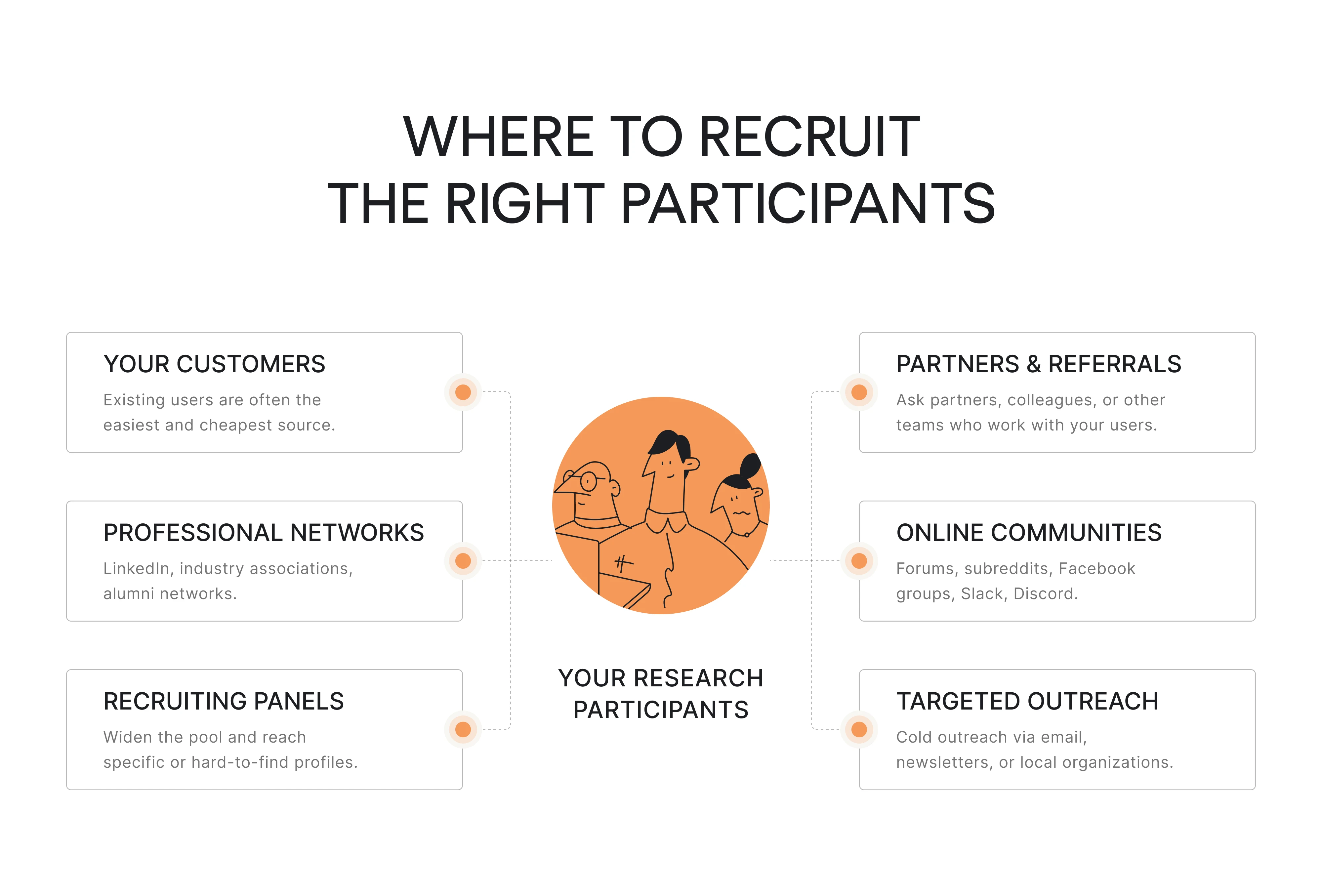
Letting you into a home or office is a bigger ask than a quick call, so offer an incentive that respects the intrusion and pay it promptly. Then recruit more people than you need, since a chunk of them will not show, and a no-show in the field costs you a whole visit rather than a rescheduled half hour.
Step 4: Handle consent and ethics
When you conduct UX research in the field, you're often in someone's home or office, filming their workspace, their face, sometimes a colleague, or a screen full of real data. That makes consent more than a formality. Before you record anything, tell people what you are studying and how the notes, photos, and video will be used.
Add that they can stop whenever they want, and get the agreement in writing.
Then take only what you need. A field visit tempts you to capture everything in sight, but every extra photo or file is something you now have to store and protect, so skip anything the study does not require.
Some groups need more care than a product team can offer on its own. If your participants are children or people in a vulnerable situation, the bar is higher, so get proper guidance before you proceed.
Step 5: Prepare your field kit
Everything now comes down to what you carry into the room. A field visit moves fast, and you cannot pause real life to figure out what to write down, so the tools that hold your attention need to be ready before you arrive. Pack a simple kit:
- An observation guide. The handful of things you are there to watch for, tied straight back to your research questions.
- A loose task list. The activities you hope to see, held lightly, since the point is to follow what people do.
- A note-taking template. A structure that separates what you saw from what you think it means.
- Clear roles. Who watches, who takes notes, who runs the conversation, decided in advance so nobody steps on anyone.
- A backup plan. What you do if the participant cancels, the setting changes, or the task never comes up.
The kit is light on purpose. Carry enough to stay organized and little enough that you can look up from the page and watch.
Step 6: Conduct field research
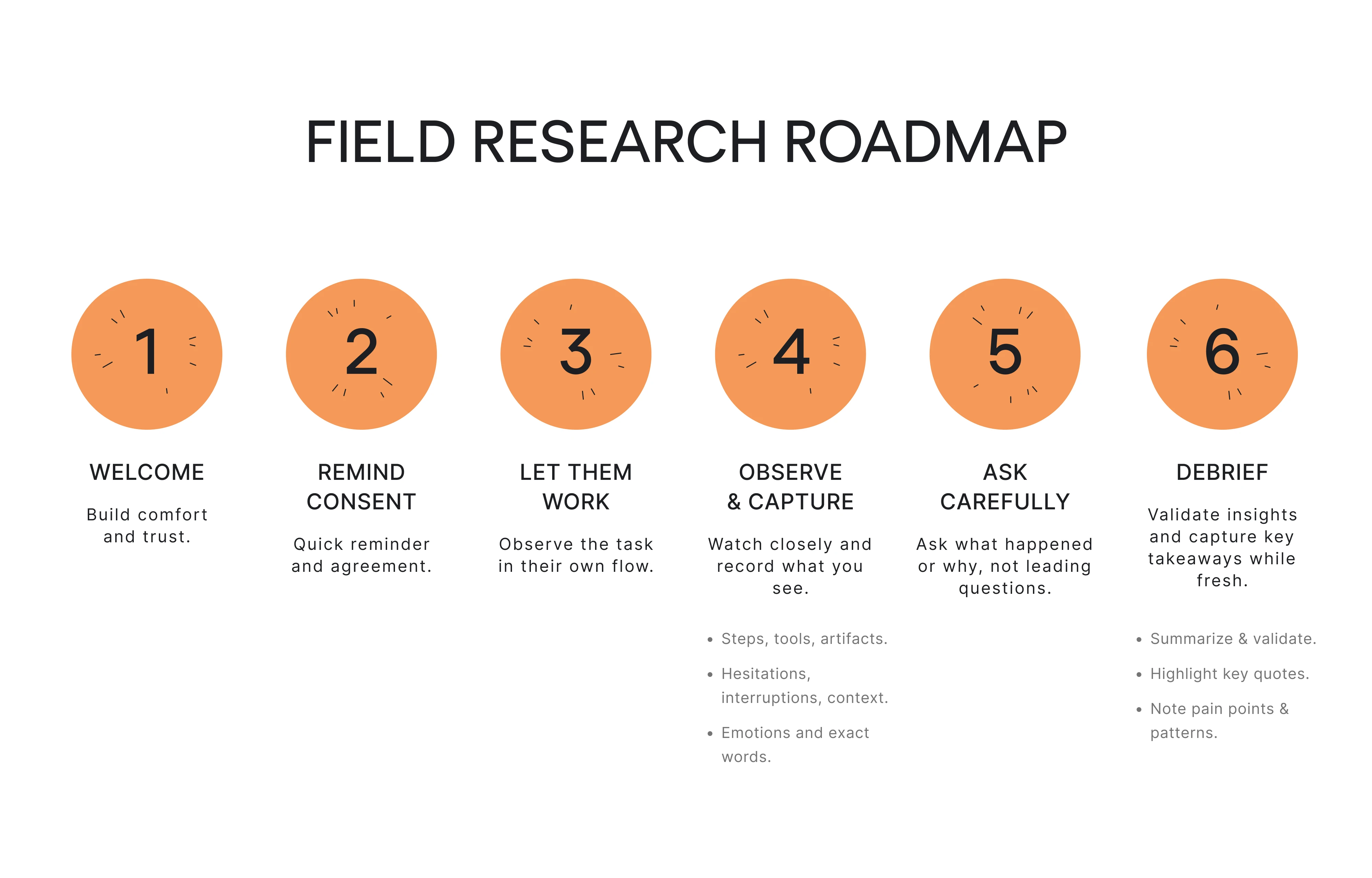
Open by taking the pressure off. Tell the person that you are evaluating the product, not them, so there are no wrong moves and their routine is exactly what you want. Warm up with an easy question, remind them of the consent you agreed to, then let them get to work. Ideally, one of you runs the conversation while another takes notes.
Then watch closely and capture more than feels necessary, recording what you see. Here’s what you should pay attention to:
- The actual steps, and the tools and artifacts people reach for.
- Hesitations, interruptions, and anything in the setting that shapes the task.
- Emotional cues and the exact words people use.
When you do ask, ask without steering. A leading question suggests the answer you expect, so ask what just happened or why they did it that way instead. And keep people working rather than letting them slip into summarizing their job from memory, which is exactly what this method exists to avoid.
Finally, debrief while it is fresh. Summarize what you think you saw back to the participant so they can correct you, then take five minutes with your team to mark the strongest quotes, pain points, and patterns before the details fade.
Step 7: Make sense of collected data
A field study leaves you with a pile of rich, messy qualitative data: the notes, photos, clips, and quotes from a handful of very different visits. The job now is to turn that pile into a short list of things worth acting on, and the trap is leaping to the one vivid moment you remember instead of what the data actually shows.
Start by grouping before you interpret.
Write each observation on its own card, then cluster the cards that belong together until themes rise to the surface. This is affinity mapping, the most common way to run a thematic analysis of qualitative research. Patterns that repeat across several people matter far more than a single striking moment.
From there, two moves sharpen the picture. A journey map lays the behavior out and marks where friction and strong feelings gather, so you can see where the experience breaks. A quick heuristic evaluation then helps you rank the problems by how badly they hurt the experience, since not every issue deserves equal weight.
Throughout, tie each theme back to a real quote or moment, which keeps you honest about what happened. The aim is prioritized insight grounded in what you saw.
Step 8: Turn field notes into decisions
This last step is where the study either earns its cost or quietly gets forgotten, and the difference is almost always in how you hand the findings over.
Make each recommendation something a person can pick up:
- The exact change you propose, not “improve onboarding.”
- Backed by a real quote or moment, so it reads as evidence.
- Given an owner and a timeline, so it lands on one plate.
- Tied to a metric the business tracks, like activation or retention.
In the end, match the format to who is reading. A leader wants a two-minute summary of the business impact, while a designer wants the detail behind it.
Tools that support field studies
You do not need a big stack to run a field study. Sometimes, a phone camera and a wall of sticky notes will carry you a long way. Still, the right tool saves time at each stage, so here is a short map of what helps where.
For finding participants, a recruiting platform does the heavy lifting:
- User Interviews to source from a large panel, or manage your own people through its Research Hub.
- Ethnio to intercept your real users through a website or app prompt.
For capturing behavior remotely or in the moment, take a look at these:
- EthOS and Indeemo for mobile ethnography and diary studies, and dscout for video “missions” people complete as they go about their day.
When it is time to make sense of the notes, synthesis tools speed up the sorting:
- Dovetail to store, tag, and cluster observations, with AI transcription to cut the manual work.
- Miro for affinity maps and journey maps, or a plain Notion doc or spreadsheet when the study is small.
And if you would rather keep everything in one place, platforms like Maze and UXtweak fold recruiting, sessions, and data analysis into a single workflow.
Final notes
A field study rarely just answers the question you walked in with. More often it changes the question. You arrive wondering which button to move and leave realizing the whole flow fights the way people work. Watching someone in their own world dissolves the tidy problem you brought and hands you the real one instead.
That is why the method rewards teams willing to be a little uncomfortable, to sit quietly in someone else's space and let their own assumptions come undone. Do that, and the product you build answers to how people live.
If you want more on choosing and conducting research that shapes real product decisions, the Eleken blog is a good place to keep reading.


.webp)

.png)
.png)


.png)


