

Product design engineer is a title that has spread faster than its definition. Most of the time, it gets read as a product designer who learned to code, which makes the role sound like a hiring convenience. We think that misses the point entirely.
This is not a replacement for product designers. It is the same craft with a longer reach, extending ownership into code-based prototyping, implementation, and post-launch iteration. The role exists because traditional handoffs stopped being good enough for teams shipping continuously.
At Eleken, we use a product design engineering approach across SaaS products, which means this article comes from practical experience. Below we cover what each role does, where they overlap, why handoffs break, and how to judge which one your team needs.
*One clarification first. In manufacturing, a product design engineer describes someone working with CAD, tolerances, and physical products. Same words, different profession. Everything here is about software.
The short answer
Both roles make the same kinds of decisions, and both make them with the same rigour. What differs is how long each one stays attached to the decision after making it. That is the whole distinction, and everything below is a consequence of it.
What does a traditional product designer do?
A product designer is responsible for deciding what gets built and how it should behave. That starts well before anything visual exists, usually with a question about why a flow underperforms or what user needs a new feature should meet.
The work moves through research, problem framing, and journey mapping, then into flows, wireframes, interaction design, and visual design. In parallel, there is often a design system to extend or maintain. A good product designer spends as much time on edge cases, permissions, and empty states as on the screens people notice.
The core skills include:
- User research to understand behavior, needs, and friction.
- Problem framing to turn vague business goals into something solvable.
- Information architecture to organize complex products clearly.
- Interaction design to define how user flows and features behave.
- Visual design to create clear, consistent interfaces.
- Communication to explain decisions and align stakeholders.
Tool fluency matters, but it ranks below judgement. The usual stack includes Figma and FigJam for design, Miro for workshops, Maze for testing, Dovetail for research, and Hotjar for seeing how people behave in the live product.
At some point, the work reaches engineering, and this is where the comparison matters. The designer hands over the files, reviews the implementation, flags issues, and stays available for questions. The engineering team ultimately owns what ships.
That boundary has a practical cost. Designers may track task success, activation, or conversion and see clearly when a number is disappointing. Acting on it is harder because the fix lives in code they do not own and a backlog they do not control.
Still, implementation is only one part of the product designer role. As one experienced designer on r/UXDesign put it:

The problem solving, decision making, and systems level thinking are the value adds that UX Design provides.

That is the foundation a design engineer and product designer roles share. The difference is how far they can carry those decisions into the product.
What is a product design engineer?
A product design engineer is a designer who takes a decision from the research that justified it to the working frontend, and then checks whether it worked. The research, flows, interaction design, and system work remain part of the job. What extends is where the work ends. A product design engineer can carry that work into a coded prototype, implementation, and post-launch iteration.
The title may feel new, but design engineering has existed for a long time. Design and frontend once sat much closer together, before growing teams pushed them into separate specialisms. Today, designers are moving closer to implementation again.
One practitioner described their own transition this way:
It started as simple code prototypes to demonstrate ideas to engineering, and became full-fledged contributions to the codebase.
That captures the role better than simply calling it a designer who codes. Technical skills make this level of involvement possible, but the important part is ownership. If an empty state ships incorrectly or an interaction falls apart with real data, the designer has the tools to catch it and work on the fix.
Day-to-day, this means the work spreads across more places. Figma is still there for design system work and for ideas that are quicker to work out by hand. Code becomes part of prototyping and UI changes, the browser shows how decisions behave with real data, and analytics show what happens after release.
The boundaries matter as much as the reach. The product design engineer role is not a designer absorbing an engineer's job. As one practitioner put it:
Figure out where you can be the most help in bridging the gap between visual designers and engineers. That’s the job.
That can mean design system work, component-level contributions, and coded prototypes. Authentication, databases, and backend architecture can stay with engineers.
The result is fewer surprises between what was designed and the final product users get.
How is a product design engineer different?
Everything in the previous section still applies. A product design engineer runs research, frames problems, and designs flows exactly as a product designer does. Five things sit on top of that.
- Prototypes are built in code. A prototype in a real component library behaves like the product, which means it can be tested on real data, shared with engineers as a working reference, and reused.
- Implementation gets validated. The difference is being able to act on issues you catch during QA. Being able to open the branch, find the component, and fix the spacing is a different level of involvement.
- Performance and feasibility enter the design conversation early. A designer who understands code can judge the effort behind a decision before it is committed to. This helps catch expensive or impractical choices.
You don't have to be a coding wizard, you just need some basic understanding how HTML/CSS/JS works. It's insanely valuable being able to look at a design and t-shirt size the difficultly level that the dev's will face when building it.
- The design system is maintained as code. Components live in Storybook and the repository rather than only in Figma, which keeps design intent intact between the documented version and the shipped one.
- Iteration continues after release. Activation and task completion data feeds back into the same loop that produced the feature, and the person who designed it is still there to act on it.
What all five have in common is a shorter path from design decision to working product. The same person can prototype the idea, catch issues during QA, keep the system current, and check the results after release. That helps features reach production faster and much closer to how they were originally designed, with fewer rounds of clarification and rework along the way.
Where the two roles overlap
It would be easy to read product designer vs design engineer as two entirely different jobs. They are not. Most of the week looks identical.
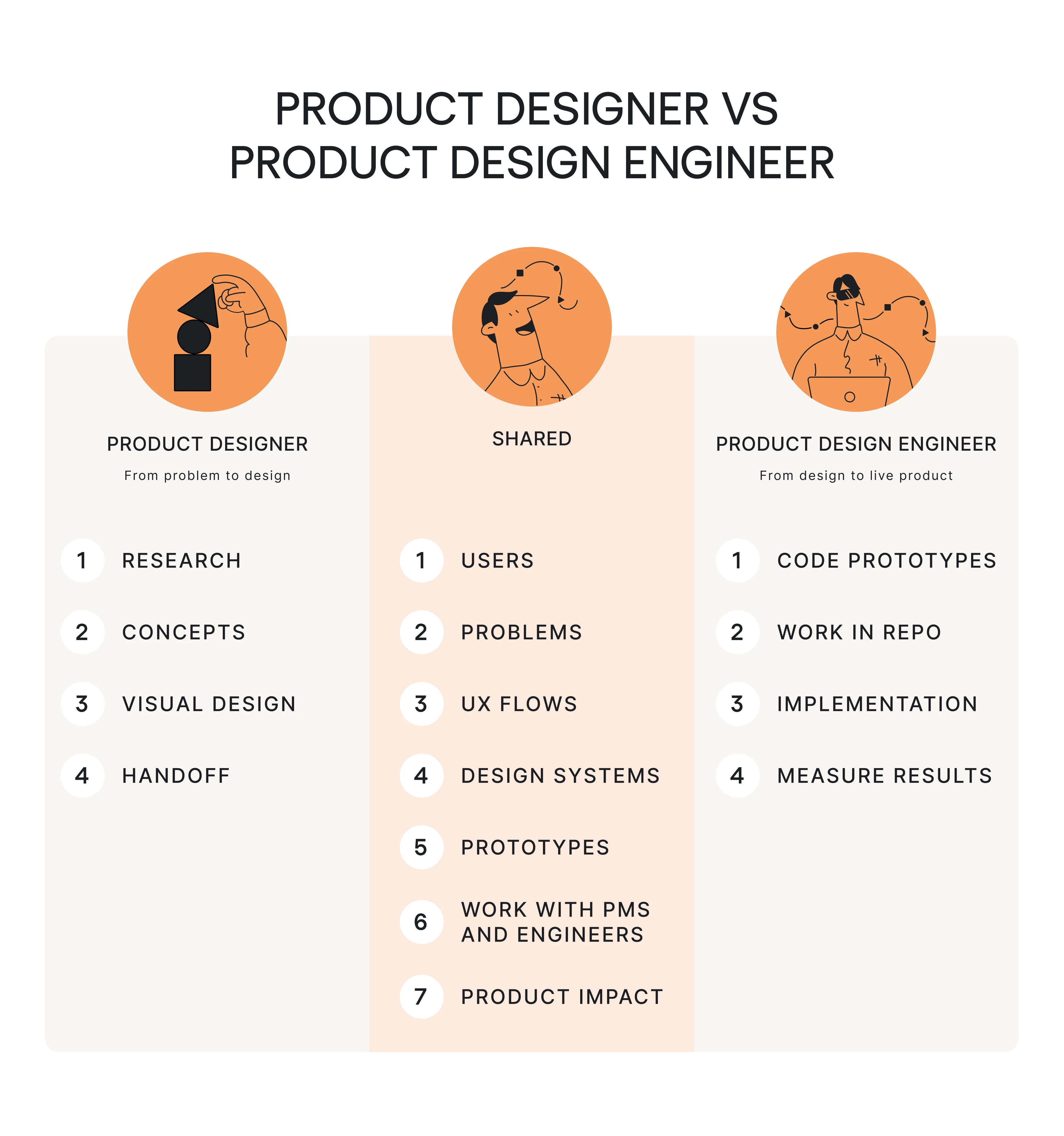
Both roles share much of the same core work:
- They talk to users, frame problems, and decide what is worth building.
- They own UX flows, interaction design, and visual quality.
- They maintain design systems and reusable components.
- They build prototypes to explore and test ideas.
- They work closely with product managers and engineers.
- They are judged on whether the product improves.
The handoff is shared too. A product design engineer does not skip it. Design specifications still get written, components still get documented, engineers still build the majority of what ships. For a product designer, the handoff usually marks the end of their direct ownership. For a design engineer role, the work continues into implementation.
Worth stating plainly that neither role exists to serve the other. Engineers contribute to design decisions, and designers stay involved as those decisions are built. Product design engineers work best in teams where that relationship already exists because they can participate more directly on both sides.
This is also why the boundary changes depending on the team. At Eleken, discovery, UX, and design system work stay constant across engagements. How far we go into the codebase depends on the client's stack, review process, and frontend setup. Sometimes that means shipping UI changes in a branch. Sometimes it means code-based prototypes. The design thinking behind both is the same.
What the product design engineering workflow looks like
Job descriptions make both roles sound similar. The product development process is where the difference becomes clearer.
At Eleken, we spent the last while rebuilding how we take a product problem to a shipped interface, and what we work from now is a loop of six phases with the same dedicated designer present through all of them.
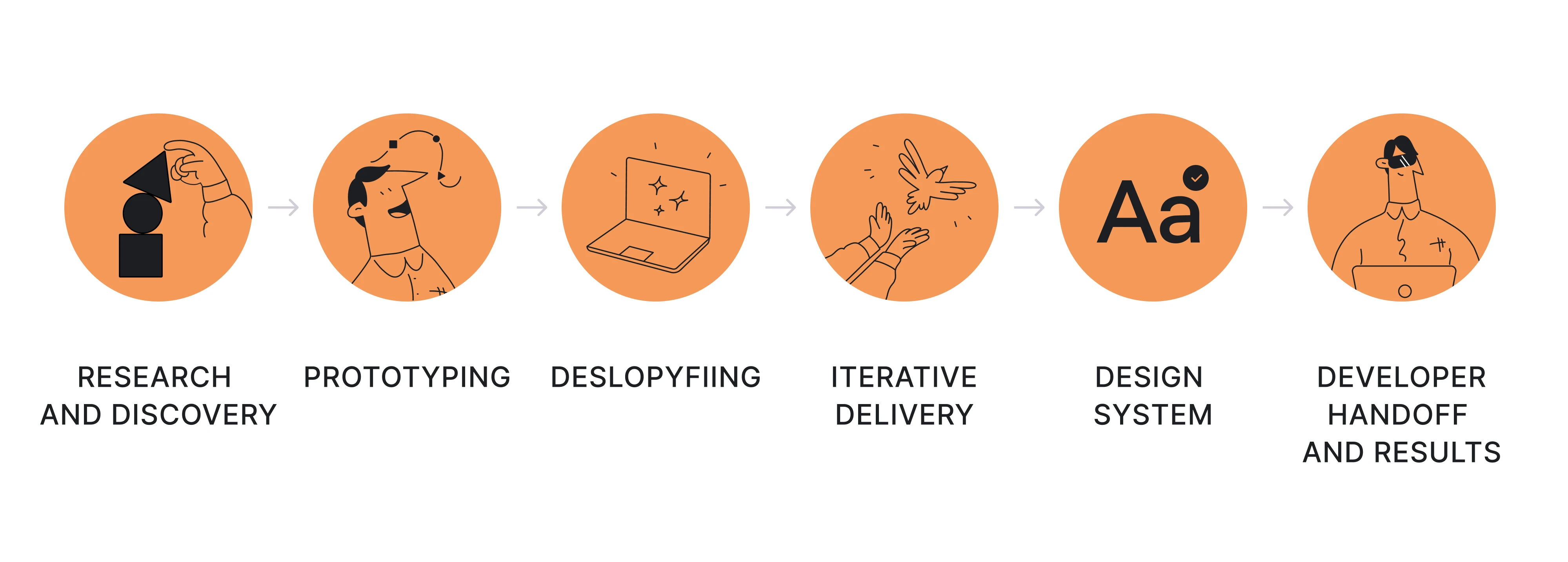
Phase 1. Research and discovery
We start by getting on a call with the client to understand the problem behind the request. Our designer then looks at analytics, support tickets, and user feedback to see where people struggle and why. Out of that comes a problem statement, a hypothesis, and agreement on which metric should move if the hypothesis is right. That metric gives us something concrete to return to after launch.
Phase 2. Prototyping
Once we understand the problem, we explore possible solutions. AI helps us get working prototypes up quickly, so we can compare several directions before committing to one. The client can open them, click through the flows, and review how each option works while changes are still easy to make.
Phase 3. Deslopyfying
This is where the designer works through the parts AI tends to miss, including states, permissions, edge cases, and the details that make a flow hold up under real use. AI can accelerate exploration, but the designer decides what belongs in the product and how it should behave.
Phase 4. Iterative delivery
The work moves forward in small, reviewable iterations. Clients see working React or HTML prototypes as the product takes shape and can comment on them directly. Figma runs in parallel for design system work, documentation, and anything that is quicker to work out by hand.
The design system grows alongside the product work. Components and their states are reused as new screens are built, keeping the prototype consistent and giving developers a working reference for the interface.
Phase 5. Developer handoff
Developers review the frontend, connect the backend, and integrate it into the product. Where the client's setup allows it, our designer may work directly in the repository and send UI changes through the normal engineering review. In other cases, developers take over with the working prototype as their reference.
Phase 6. Results
The metric agreed in the first phase gets checked once the feature has been live long enough to produce data. We might return to activation, conversion, task completion, feature adoption, or support volume. The result tells us if the hypothesis worked and gives us evidence for the next iteration.
AI changed the pacing of this more than the structure. Research through PRD to a working prototype used to take somewhere between five and ten days. With coding agents in the process, it can move much faster, provided the designer brings the domain judgement to direct it. It means a team can compare three structural directions in the time it previously took to produce one.
This is the high-level version of the process. In our design-to-code workflow article, we break down how it works in practice, including prototype reviews, design system setup, code delivery, and the mistakes that can bring the Figma-to-code gap back.
Skills and tools a product design engineer needs
Design engineer skills usually get answered with a stack. React, TypeScript, maybe Storybook. That is the least interesting part of the answer and the easiest to fake, because a designer can learn enough React to produce something that runs while still making decisions a frontend team has to undo later.
What separates the role is the design work getting more demanding.
- Edge case coverage becomes a design responsibility. When a prototype has to run, a missing loading state becomes obvious immediately. The same applies to permissions, long content, empty accounts, and the difference between a table with four rows and one with four thousand.
- Design system thinking has to extend into the codebase. Naming a component in Figma is different from deciding whether it should exist in the repository, what it should accept as props, and whether an existing component already does the job. Those decisions affect the system engineers work with.
- Feasibility enters the design conversation while the decision is still open. Technical knowledge helps designers understand how difficult something will be to build before committing to it. That can catch a layout that breaks responsively or an interaction that costs a sprint.
- Judgement still has to come from design. Technical skills can pull the role too far into implementation. The goal is to use that knowledge to make better-informed design decisions while keeping the focus on the product and its users.
- Constraints have to be communicated without stopping the work. Knowing that something is expensive to build only helps when the team understands the tradeoff and can decide what to do with it.
On the technical side, the honest minimum is reading a codebase confidently, working in HTML and CSS without guessing, enough JavaScript and React to build and modify components, comfort in a browser's developer tools, and enough git to work on a branch without someone supervising.
The tooling sorts into five groups.
The last group is moving fastest and matters the least on its own. A coding agent that reaches a product's tokens and components through the Figma MCP server with Code Connect and through Storybook MCP can accelerate a designer who already knows what should be built. Without that knowledge, it can produce convincing screens quickly while making poor decisions underneath.
Which role does your team need?
Both roles can research a problem, decide what to build, and design the experience. The choice comes down to what happens after those decisions are made.
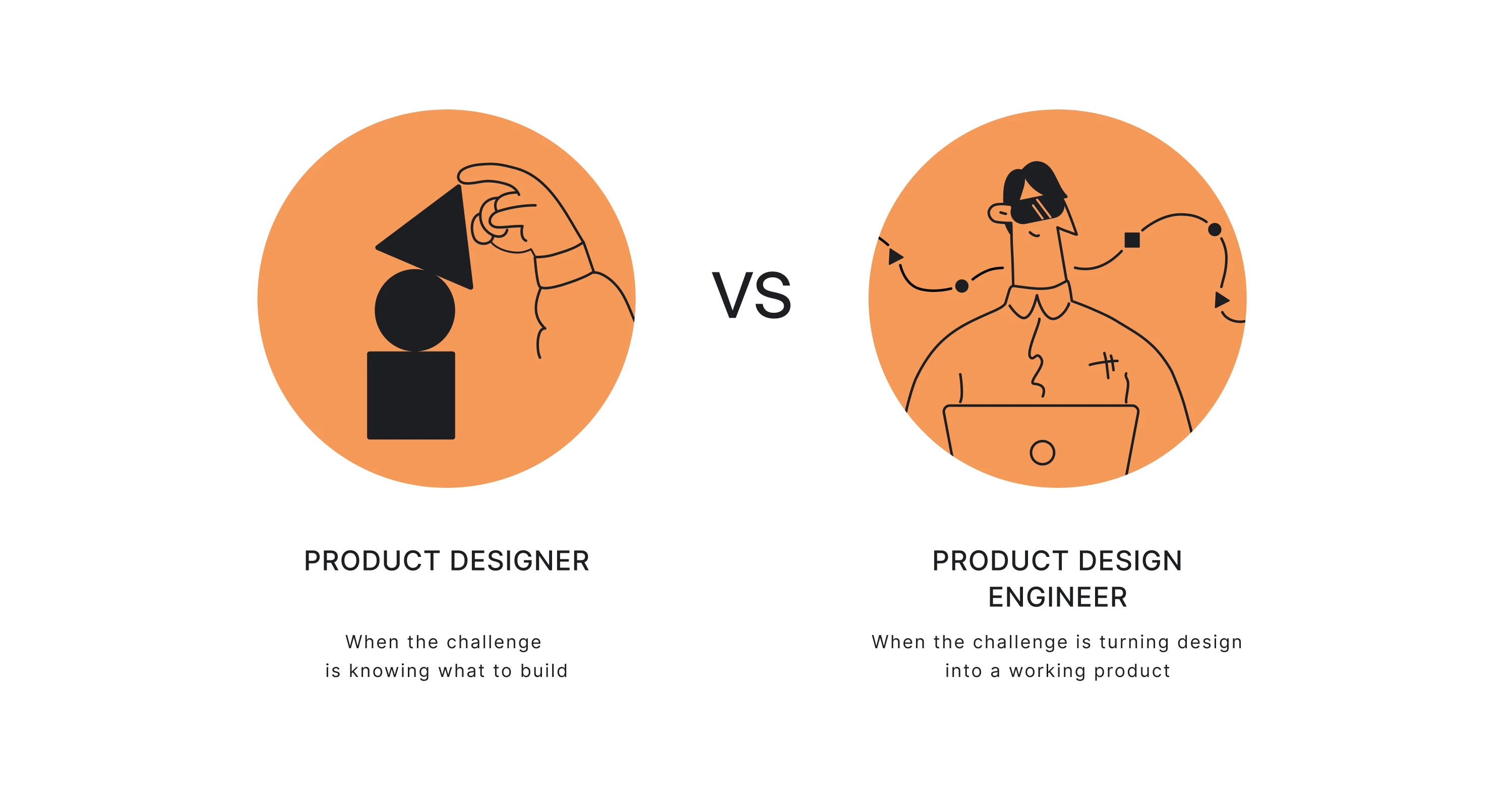
A traditional product designer can be enough when the path from design to production already works well. If designers and frontend engineers collaborate closely, the design system stays aligned with the codebase, and implementation rarely changes the approved experience, extending the designer’s ownership into code may add little.
A product design engineer becomes useful when that path starts to break down. There are four situations where the extended ownership makes a difference.
Design and code have drifted apart → Someone needs to keep both sides of the component library aligned. This becomes especially important when engineers use AI to build screens, since both the team and AI agents need clear component rules.
Decisions keep getting made twice → If flows are approved in Figma and then redecided during implementation, the version built in code is ultimately what users get.
You need confidence before committing budget → A prototype running on real components and data can answer questions that a clickable mockup cannot.
Theming, responsive behavior, or accessibility keep breaking → These depend on the system underneath. Shared tokens and components make changes easier to apply consistently across the product.
Hiring for this is the hard part. TrueUp, which tracks openings across more than 9,000 tech companies and startups, listed around 5,700 open design roles globally in March 2026. As of September 2026, that number sits at roughly 2,500. The pool of design jobs has halved in half a year, and the pool of designers has not.
On top of that, Figma's State of the Designer 2026 survey found 56% of hiring managers reporting rising demand for senior designers against 25% hiring more juniors, so the competition concentrates exactly where a product design engineer would sit. Adding frontend capability on top of that narrows the pool again.
That leaves three realistic routes. Hire, if you can find someone and the workload justifies a permanent seat. Upskill a designer you already have, which works when the appetite is genuine and fails when it is assigned. Or bring the capability in through a partner, which is the route most of our clients take, since it gives them the workflow without needing the hiring market to cooperate.
At Eleken, the last option means working with one dedicated designer who stays involved across discovery, design, prototypes, and implementation. A full-time designer costs $6,599/month, while part-time engagement costs $4,599/month. This gives teams access to the workflow without adding another permanent role.
Wrapping up
The interesting thing about this shift is how far design ownership can extend. For years, designers argued for a role in strategy while their output often stopped at a file. Product design engineers carry those decisions further into implementation.
That does not make the role necessary for every team. Many work well with a clear separation between design and engineering. The question worth carrying away is narrower than which role to hire. It is whether anyone owns the gap between what was designed and what users get. If nobody does, that gap will keep growing.
If that sounds familiar, talk to us. Bring one flow that underperforms or an interface you want to modernise. We will look at the evidence before anyone opens Figma.