

The main reason why startups fail is a misunderstanding of market needs. Of course, it doesn't make sense to create a product nobody wants. But very often, the idea of a new product seems great only in our minds (until we implement it).
Therefore, it is very important to test the product to understand if it satisfies people's needs.
For example, when we worked on the design of TextMagic, a customer experience platform, we analyzed users' feedback after creating each prototype. It helped us develop new ideas and understand what improvements we should make.
But what if the budget is limited and you can't afford to test every small piece of the product? Moreover, the second reason for startup failure statistics is running out of budget.
The best solution to this situation would be to design an MVP.
In this article, you will learn what is an MVP, what are its main types, and how to build a minimum viable product to validate your idea and spend minimum resources.
What is a minimum viable product (MVP)?
Imagine you've got a brilliant business idea and all your close ones liked it and encouraged you to try. Can you be sure they did so not only because they didn't want to hurt you and break your relations? Before investing every single penny into developing a full-featured solution, you need to check your hypothesis with a broader, unbiased audience.
Minimum viable product, or MVP, helps you address the core problem your target customers face. It’s a simplified version of a product with the minimum feature set you can show to the target market, test with real users, and improve based on their feedback.
The main purpose of an MVP is to test the essence of the product idea, analyze users' feedback, and create a full product version based on the insights. In the B2B world, the experts say that it's not an MVP until you can't sell it. The picture below perfectly illustrates a proper MVP approach.

Many successful companies serve as proof of the usefulness of MVP product development. For example, Daniel Ek and Martin Lorentzon launched a small service in 2006 with one function - music streaming. Today, their product, Spotify has a $ 50 billion market valuation, has partnerships with big recording studios, and has a 50 million active audience.
In 2008, when renting a hotel or accommodation while traveling was a big problem, two enthusiasts found an unusual way to solve this issue and decided to rent out their apartment by fax. In fact, this was also an MVP, which main function was to test. The experiment showed that the product will be in demand, and today Airbnb is one of the largest sites for finding short-term rental housing.
The MVP product shouldn't necessarily have a fancy design, which can distract users' attention from understanding the product value. Though the UI and UX should be intuitive and easy to follow. We'll come back to this point later when talking about the MVP examples. And before, let's see what perspectives building a minimum viable product gives to a SaaS entrepreneur.
What are the benefits of building an MVP?
Strictly speaking, all benefits can be boiled down to one phrase - “product market fit.” Elaborating more, we'll find that creating the MVP helps:
- Understand if there is a market for your idea
- Evaluate product’s potential
- Gather customers’ insights
- Reveal a product’s weak points
- Attract investors for future funding
- Enhance your product to satisfy market needs
- Reduce engineering hours narrowing down the feature set
- Avoid unnecessary expenses
In a nutshell, the minimum viable product is a cost-effective learning tool that helps test the idea and understand whether to invest in the deployment of future versions. This approach is central to design thinking for MVP development: it’s about learning as much as possible with as little effort as possible.
By identifying exactly what users need before building the full software suite, you can effectively build MVP and save budget for the features that actually drive growth. At Eleken, many clients come to us for MVP design for exactly this reason — they recognize how much clarity and speed an MVP gives them. With thoughtful UI/UX, we help founders validate ideas faster and support their early success with design that highlights the product’s core value.
Four common types of MVP
There are many different approaches to create an MVP, let's talk about the most popular ones.
Flintstone's MVP

Do you remember how in the popular cartoon The Flintstones father created the illusion of moving by car (there was no fuel, he was just running inside of a vehicle)? Flinstone's approach (also known as The Wizard of OZ MVP) provides the imitation of the product functions, although those functions are technically not implemented. MVP aims to test a hypothesis, to prove the viability of the chosen business development model.
Initially, this approach had many critics. Nick Swinmurn, the founder of the online store Zappos, proved the consistency of this method. He created a website and posted photos of different shoe models. When Nick received his first orders, he went to the store and bought the pair he needed and sent it to the customer. This way Swinmurn checked the viability of the idea of selling shoes via the Internet, while initially he did not spend money on renting a warehouse and purchasing products, but only imitating their availability. The market value of Zappos reached $2 billion in 2015.
Concierge MVP

This methodology is suitable for online services, the ultimate goal of which is to automate solving problems of the target audience. At the initial stages of implementation, you manually provide the service.
For example, if you want to launch a financial accounting service, you don’t need to start MVP from scratch with a complex software build. To test if this idea will be in demand, first you make some financial plans for clients manually through Excel. This way you can see if people are willing to pay you and how much are they willing to spend. As well, you can check what features are the most important for your audience and need to be implemented first.
This model was used in the late 90s by Chuck Templeton, the founder of OpenTable, a service for online reservations. He did not immediately invest thousands of dollars in the technical implementation of the service, but booked tables in restaurants for other people manually. So Chuck checked the viability of the idea, understood how much potential customers are ready to pay, and learned about his audience.
Piecemeal MVP

Use the piecemeal MVP method when it is possible to test and implement the idea without developing unique software. To use this type of MVP you collect already existing services and tools and combine them in a single interface. It allows you to save money and time you would spend on developing your own technology.
An example here would be Groupon, an online coupon provider. In the beginning, it was a WordPress site where all user interactions were done via email. Only after receiving feedback and financial results they developed social features, full-fledged email distribution, automation, and finally a popular mobile application.
Single featured MVP

This type of minimum viable product is used when there is a product with a minimum set of functions (usually one feature). We've already mentioned Spotify that used this type of MVP. In the context of demo vs prototype vs MVP, this approach moves beyond a simple demonstration to offer a real, functional tool that solves a single pain point.
The release of a product with only one feature allows your customers to clearly understand what problem they may solve with your service. As a result, you will clearly identify your target audience, get feedback, and then start MVP testing. This focused development path is a proven way to manage your initial MVP cost by avoiding unnecessary complexity early on.
An example of a minimum viable product from our portfolio would be LittleDate. This app helps people make their dates short and secure. According to the idea, your first date should last no more than 20 minutes. If you stay longer, your rating within the app will go lower. You won’t need to make excuses anymore if you want to escape soon after the date starts. Isn’t it a relief?!
Our designer team brainstormed on this awesome idea and created the UI/UX MVP design for the LittleDate iOS app. The ultimate goal was to make the app design intuitive and easy to follow, customer-focused, engaging, and not dull.

Not to visually overload an interface, we made the user profile minimal. It includes only the necessary information - a user's photo, rating, and the number of dates they have had.
We used the scroll down instead of the swiping motion, the most popular UI mobile pattern for dating apps, to encourage actual users to be more serious in finding a match and not just play a “swipe and like” game. Also, we designed availability, scheduling, and “running late” features to make the app a handy date companion.

How to create an MVP?
Now, as we've discussed some theory, let's talk about the practical part - creating an MVP. Eleken designers strongly recommend using design thinking in building an MVP.
To get a good result, break down the work into steps to build an MVP, outline goals for the team in general, and tasks for each member in particular. But first of all, make sure your team understands the general principles of work and product creation.
Stage zero: Define the basic principles
Hold a general meeting of the team that will participate in the development of the minimal viable product. Figure out whether all team members understand what you are going to do and why. Discuss the vision of the MVP, put it all together, and build the first rough plan for further work. This initial alignment is a core pillar of MVP product management, as it ensures every stakeholder is pulling in the same direction.
During the general meeting, discuss the following issues:
- How to spend minimum resources? Remember you should create an MVP with minimum time, money, and effort. Figure out how to spend less, but still effectively test your business idea. As a rule, a discussion of this issue helps to select the MVP functionality to implement at the initial stage of new product development.
- How to interact with users? One of the main goals of creating an MVP is testing hypotheses, determining the demand and relevance of the product. Feedback from the target users of the product helps to reach this goal. In order not to miss any important information, think about how you will interact with the target audience: reviews, surveys, direct interviews, etc.
- How to make the first sales of a product? The first sales of the product will provide the means to continue further development and show if someone is interested in your product. You can also consider organizing fundraising (pre-sale) on a crowdfunding platform, like Kickstarter, for example.
- How to promote a product? Plan the advertising campaign and the channels you will use for it. The main tool here is usually Google Adwords. Then choose social networks (Facebook, Instagram, etc), create official pages there, and launch targeting. Social networks are also great channels for collecting feedback. Develop a selling landing page: describe the product, tell about all the features and benefits for the client, and give early customers the opportunity to choose between the paid and free versions of the product.
In this team meeting, try to involve as many specialists as possible to consider the idea and testing options from different points of view.
Stage one: define the problem the MVP will solve
After defining the basic principles of MVP, answer the question: "What problem does the product solve?". This clarity is why MVP design matters; without a defined problem, the design lacks a functional compass.
Describe its value in a few sentences. It will be useful for you and your team, and in the future, it will help in creating a core value proposition, landing page, and advertising campaign.
Stage two: define the target audience
A common mistake aspiring entrepreneurs tend to make is that they believe their product solves the problem of a wide audience. Instead, you should focus on a specific target audience.
Create a user persona, a customer who will definitely buy your product. Describe their gender, age, social status, income level, needs, habits, and even the devices they prefer to use. Define what common problems they have and want to solve.
Don't hurry! It is better to spend a few more hours to define the target audience than spend the entire advertising budget and get the minimum conversion.
Creating the user persona gives an understanding of whom you are going to sell the product to. This information will help in organizing an advertising campaign.
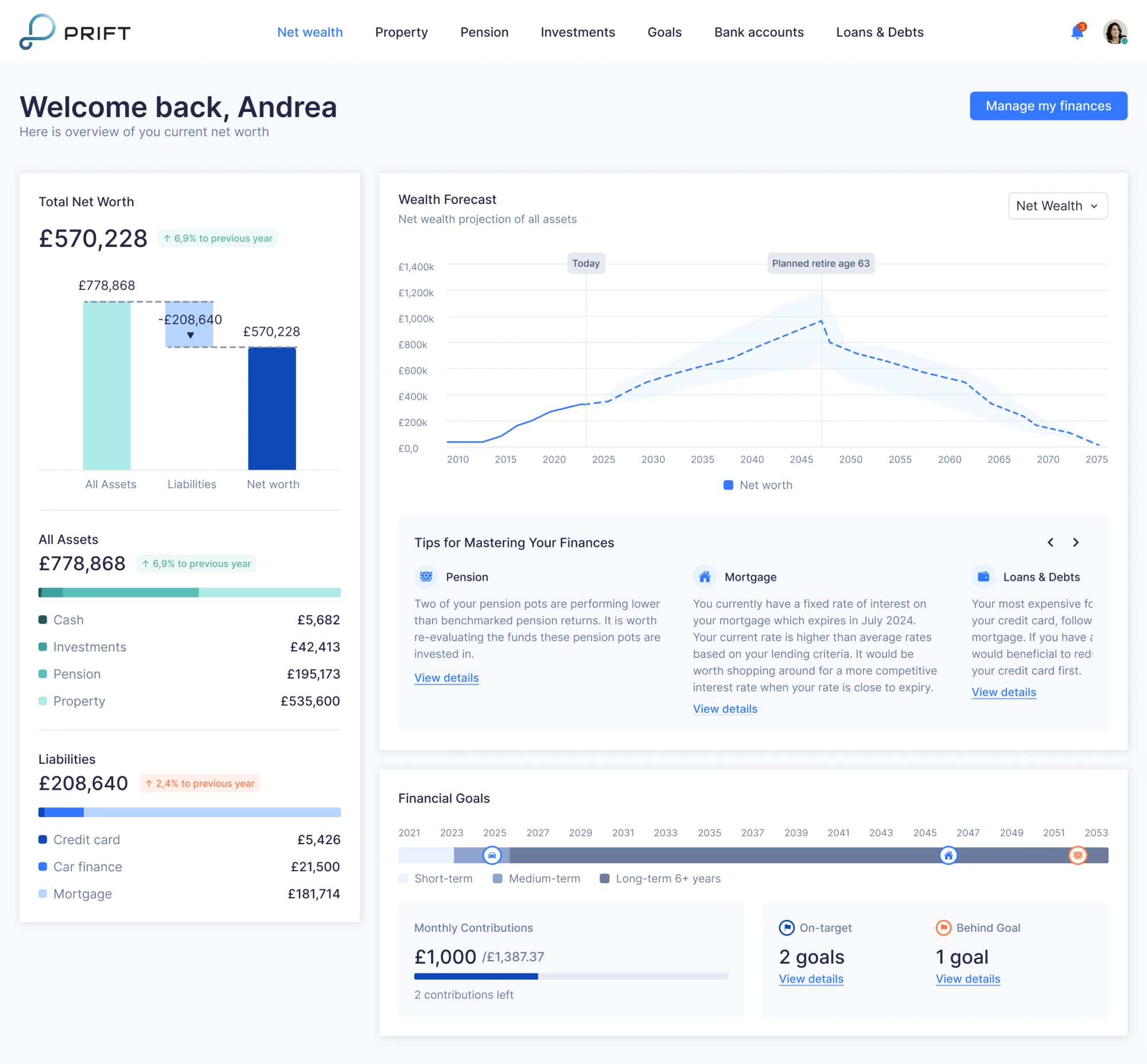
At Eleken, we relied on this approach when designing Prift, a personal financial assistant. During user research, we discovered that one of the key audience motivations was the desire to “put money to good use” and move toward financial freedom.
Keeping this in mind, our designer created screens without excessive gamification and focused on a restrained, minimalist design that aligned with users’ expectations. The client appreciated how clearly the solution reflected their target audience’s needs.
Stage three: research the main competitors
It is challenging to develop a completely unique product or idea. If you have not come face to face with a similar proposition it doesn't guarantee that you haven't got competitors.
You should spend a lot of time on market research. You are lucky if the idea is still unique. (in this case, we recommend to read about the Blue ocean strategy ).
If you managed to identify some rivals then do the following:
- Collect as much information as possible about the competitive landscape. Analyze your top three competitors: study the history of development, check what products they offer, learn their unique value proposition, and evaluate if you can offer something better.
- Study the position of competitors' companies in the market. Determine their strategies, sales volumes, and calculate profitability. This way you will understand how successful they are and what you can do to beat the competition (and most importantly, how much resources will you have to spend).
- Learn how those companies present themselves. Find the information that competitors publish about their activities, check out their official websites, presentations, annual reports, ads campaigns, etc. It can give new ideas for your product development.
- Learn what other channels say about your competitors. Check news, videos, reviews, interviews, ratings, etc. that present some information about your rivals. It will help you better understand the chosen industry and learn more about the situation on the market.
To know better how to behave in a highly competitive market place read Red Ocean Strategy: How to Overcome Competition.
Stage four: create a user journey map
It's super important to design a usable and easy-to-navigate application. To understand if your product provides a good user experience, test it yourself. If you have some troubles while using the service, then the consumer will definitely not be able to figure out how your product can help them.
To avoid such a problem, when creating the MVP design for SaaS, build a customer journey map. It will show what the active user does when interacting with the product. You must understand what content, design, and interface the audience expects to see.
As well, do not forget to make edits to the user journey map after receiving feedback from the first customers. Feedback will show you what is working well and what is inconvenient and is better to change. Based on this information, adjust the map so that end-users get what they want. This iterative refinement is the bridge between a minimum lovable product vs minimum viable product; while the MVP focuses on the journey's completion, the MLP focuses on making that journey delightful.
Stage five: define the features
At this stage, you must define the functionality of the MVP, or in other words, plan the scale of the minimum viable product.
First, define a few basic features, those without which the project cannot exist. This is the wireframe or the smallest usable version of the product.
Next, think of other features you want your product to possess and prioritize them. Define which functions are essential and need to be implemented at once, and which you can add later in the process of project development.
It is better to set function priorities together with the team. Discussions and disputes will lead to the determination of the optimal scale of the minimum viable product.
When we designed Prift, we followed this logic closely. To prioritize features, our team used the MoSCoW method. We listed all potential functions and categorized them into must-have, should-have, could-have, and won’t-have.
Since we were building an MVP, we focused only on what users absolutely needed at the initial stage, specifically, long-term personal finance forecasting. Narrowing the scope this way helped us deliver meaningful value early while keeping the product lightweight and efficient.

Stage six: develop and test the MVP
You are almost there! You have a great idea, you've defined tasks, goals, and scope then it's time to develop the MVP and test it.
Test your MVP in two steps. Firstly, when the MVP is ready let your team use the product for several days. If everything is okay give access to the product to the first users. Let them test it for 7-14 days.
Then gather feedback, statistics, behavior analytics, and analyze the entire data set. You will see what features to improve, what functionality to remove, and what to add.
The testing stage of the product will help you come up with an optimal first version that you can bring to market and continue improving.
This was the last out of seven steps of the minimum viable product development process. Let's once again recall each of them:
- Define the basic principles of creating an MVP
- Define the problem the MVP will solve
- Define the target audience
- Research the main competitors
- Create a user journey map
- Define the features
- Develop and test the MVP
When and why do you need to develop an MVP?
Create a minimum viable product at the introductory stage of the product life cycle. The idea of the product can only seem great in theory, so there is no need to risk and invest a lot of money in building the full product. The MVP development process allows you to spend less and get all the needed data to test your idea.
After the release of the minimum shippable product, you will determine the demand and understand whether you are developing the project in the right direction or not.
But the greatest thing about MVP is collecting valuable information from early adopters. It is the end consumer who will tell about the correct implementation of the project. Use the collected data to plan future upgrades and prioritize which features to implement first.
Myths about MVP development
Despite the seeming simplicity of the MVP concept, many founders still approach it with mistaken expectations. These misunderstandings often lead teams to build either too much, too little, or simply the wrong thing entirely. So, let's clear up some of the most popular myths.
Myth 1: MVP is a low-quality product
This way of thinking can do you a huge disservice. A viable version of your product should contain a limited number of features, and this is true. But the quality must be as high as you can ever provide. An MVP is “minimum” in scope, and many founders mistakenly cut corners on UX or reliability.
The MVP's ultimate goal is to attract early adopters, introduce your idea, and see if it is welcomed by the market or not. Poor product quality won't make a good impression by default, bringing your efforts to nothing. Early adopters are often the most critical users you’ll ever have, and if their first interaction feels clunky or unfinished, they’re unlikely to return.
A range of unsuccessful products have already proven that MVP design matters. Nowadays, the word viable is often displaced by lovable to underline the importance of making a product that people really enjoy using. We have a separate article about MVP and MLP.
Myth 2: MVP helps gain first users
On one side, yes. The early adopters will be your first audience. However, the MVP is not a marketing strategy. It's rather a development technique that enables developers to create better products based on customer feedback. Its purpose is to validate assumptions, and expecting an MVP to instantly bring traction often leads to disappointment.
In many cases, early users appear only after deliberate outreach, interviews, or targeted testing campaigns (not simply because the MVP exists). Treating the MVP as a growth engine can shift focus away from learning and toward vanity metrics, which undermines the entire point of the process.
A strong MVP helps you understand whether potential users would use the product, why, and under what conditions. Once the core value is validated and refined, only then does it make sense to invest in marketing or scalable acquisition channels.
Myth 3: MVP is a prototype
Not necessarily. It depends much on your product's nature. Landing pages, mockups, or demo videos of a non-existing product will also work. The goal is to deliver the product's idea essence, and the form can be one of the listed below:
- Prototype
- Piecemeal MVP
- Wizard of Oz MVP
- Concierge MVP
- Landing page
- Demo video
- Product design
The key distinction is that a prototype helps you explore a concept, while an MVP helps you test how real users respond to it in practice. Confusing the two can cause teams to release something that is too rough for the customer base or too polished for learning.
The successful MVPs strike a balance — they don’t try to solve everything at once, but they still function well enough to gauge user interest and behavior.
Conclusion
After gathering all the theoretical information about MVPs and completing the seven stages outlined above, you’ll have a solid minimum viable product that can grow into the first version of a full-fledged project.
Don’t be afraid to make changes along the way. MVP development is an iterative process, and the sequence of steps described in this article isn’t a strict rule but rather a framework you can adapt to your needs.
And if you need a UI/UX design for your future product, just drop us a line, and we'll visualize your idea.



%2520cover.png)


