.webp)


Choosing a healthcare design agency goes far beyond finding a team familiar with healthcare. In this industry, compliance, complex workflows, accessibility, and reliability are non-negotiable – any competent agency has to account for them.
The real challenges lie elsewhere.
- One is identifying teams with hands-on healthcare experience, supported by real case studies and tangible outcomes.
- Another is understanding the practical side of working with an agency: their engagement models, pricing, collaboration style, and how well their process aligns with your product, workflow, and business goals.
In this guide, we share a vetted list of healthcare UX and web design agencies and help you look beyond portfolios — covering what to expect from the design process, common engagement models, red flag checks, and the right questions to ask before signing a contract.
10 healthcare UX and web design agencies (2026 shortlist)
Below is a curated list of battle-tested healthcare UX and web design agencies with proven experience in complex healthcare environments. Each brings a different strength — from enterprise transformation to SaaS-focused iteration — so you can match your priorities with the right type of partner.
1. Eleken – fast-moving healthcare SaaS + complex B2B workflows
Eleken is a remote-first UI/UX design agency for SaaS products, with a solid track record in healthcare and other regulated domains. The team excels at designing dense, multi-role workflows and data-heavy interfaces common in healthcare SaaS, bringing their practical know-how in HIPAA-compliant design and other strict regulatory contexts.
Overview:
- Founded: 2015
- 100% SaaS focus
- Team size: 100+ specialists
- Pricing: $6,599/month for a full-time designer or $4,599/month for part-time, with the flexibility to cancel anytime.
- Collaboration style: async, a fully dedicated designer joining your team, no PM layer
- Notable healthcare clients: Refera, Populate,HealthStream, b.well,
Brief portfolio overview


Eleken has earned a 4.9-star rating on Clutch, backed by 116+ reviews from SaaS founders, product managers, and CTOs.

Clients frequently highlight Eleken’s ability to work at startup-like speed and untangle complexity, designing human-centered experiences that are built to last.

Why choose them
Eleken is a strong choice for complex healthcare SaaS apps that need ongoing design support, steady iteration, or thoughtful legacy redesigns at a flat price without surprise fees. Their subscription model, trial-first approach, and experience with regulated, data-heavy systems make them well suited for companies that need a flexible design partner closely integrated into their workflow without trade-offs in quality and design consistency.
Strong points
✔️Healthcare UX fluency: designing human-centered experiences with a solid grasp of domain-specific constraints
✔️SaaS-focused design talent: carefully vetted, internally trained top 1% designers with ongoing peer and leadership support.
✔️ Embedded workflow: direct collaboration with designers, not through layers of PMs.
✔️ Predictable pricing: flat monthly rate that’s easy to budget for and scale.
✔️ 3-day free trial: rare among UX agencies, and genuinely useful for early fit validation.
Things to consider:
– No in-house development: focuses exclusively on UX/UI design (you’ll need an engineering team ready to implement)
– Not website-centric: less suitable for teams looking for standalone healthcare marketing website designs.
2. Qubstudio — brand + product transformation in healthcare

Qubstudio is a digital product design agency with strong SaaS and enterprise UX experience in healthcare and other complex domains. The team often works on products where design needs to bridge brand, usability, and long-term product vision, including platforms with multiple user groups and layered requirements.
Overview:
- Founded: 2007
- Team size: 50+ specialists
- Pricing: $50 - $99/hr, min project size $10k, offers packages for scaling teams
- Collaboration style: a dedicated external design team with a PM and frequent status updates
- Notable healthcare clients:Ademrius, Candesic, Lane Health
Brief portfolio overview


Qubstudio holds a 4.9-star rating on Clutch across 90+ reviews, with clients praising their responsiveness, unique visual skill and ability to blend creativity with strategic product thinking.

Their process is well-structured, deliverables are on the frontline of the modern trends, and their dedication to breathing deep meaning into every element is stellar.

Why choose them
Qubstudio is well suited for healthcare teams searching for a holistic design partner, covering everything from UX/UI to brand identity and assets for marketing strategy. Their strategic product mindset, combined with an artsy approach and careful attention to how each decision fits into the bigger picture, is what truly sets the quality of their work apart.
Strong points
✔️Usability-led healthcare design: delivering highly functional interfaces without compromising visual appeal
✔️Holistic brand delivery: outstanding brand support across product and marketing touchpoints
✔️Efficient PM collaboration layer: expect clear communication, regular updates, and predictable execution
Things to consider:
– No in-house engineering: they provide only UX and design work, so development and implementation are carried out externally.
– Thorough by default: they place a strong emphasis on meaning and nuance, so early alignment on expectations is important.
3. Cieden — complex healthcare interfaces, compliance-aware design

Cieden is a UX/UI design agency known for helping B2B SaaS and healthcare products solve complex UX challenges through a research-first their team is savvy in turning product vision into reality, proactively challenging assumptions and grounding design decisions in a deep understanding of the healthcare domain and its nuances.
Overview:
- Founded: 2016
- Team size: up to 50 specialists
- Pricing: $50-$99/hr, $10k min project size
- Collaboration style: A dedicated senior designer who cohesively integrates into your flow and cooperates with your team.
- Notable healthcare projects: Sidekick, MedEntry, telehealth (NDA), united healthcare data app (NDA),
Brief portfolio overview


Cieden holds a 4.9-star rating on Clutch, and many of its clients have remained loyal for years, returning for additional projects.

Clients praise their strong collaborative approach, proactive problem-solving, and ability to deliver gorgeous-looking products in a quick turnaround time.

Why choose them
Cieden suits perfectly for teams working on complex B2B healthcare products that need design clarity before scaling. They often start with a deep-dive discovery phase, which helps them forge well-grounded design decisions. With niche knowledge and established processes, they bring in a mature, well-informed perspective to designing healthcare products that are both functional and genuinely user-friendly.
Strong points:
✔️ Solid healthcare UX expertise: delivery with grounded domain understanding and healthcare-savvy leadership
✔️ Well-structured processes: clear stages and smooth coordination that help establish alignment early on
✔️ Proactive problem-solving: sharp focus on solving UX issues with a research-first mindset
✔️Full-cycle delivery: have internal dev capabilities to handle implementation of design assets
Things to consider:
– Room for QA improvement: some clients wish for better QA processes to avoid inconsistencies
– Variable final cost: teams should expect cost adjustments if requirements change or expand during the project.
4. UX studio — research-heavy simplification, usability testing

UX studio is a design agency known for its research-heavy approach and experience with complex B2B products, including modern healthcare apps. In addition to client work, the team has built and launched its own products, which gives them a practical know-how of what it takes to turn UX decisions into measurable results in real-world product environments.
Overview:
- Founded: 2013
- Team size: 70+ specialists
- Pricing: $50-$99/hr, $10k min project size
- Collaboration style: an embedded product designer joins your team, no added PM layer
- Notable healthcare projects: Glide, Korero, Oxa
Brief portfolio overview


With a 5-star Clutch rating and over 40 reviews, clients highlight the team's professionalism, ability to quickly grasp industry-specific challenges and overall responsiveness.

They're particularly helpful when building something technical that requires in-depth research.

Why choose them
UX Studio is a smart choice for healthcare teams that want user insights to actively shape product direction, not just confirm assumptions. Their enthusiastic, research-driven culture treats user-centeredness as a core discipline that informs decisions throughout the entire product lifecycle.
Strong points
✔️ Research-first UX practice: heavy emphasis on user research, testing, and validation to inform design decisions
✔️ Designer–researcher setup: pairing the two enables rapid iteration and insight-led decisions
✔️Free trial option: a risk-free opportunity to pilot engagement before committing long-term.
Things to consider
– No in-house engineering: development and implementation typically require external dev support.
– Speed-sensitive fit: their extensive emphasis on discovery and validation may not suit teams that need quick turnarounds and fast-paced delivery.
5. ELEKS — enterprise healthcare systems + engineering/integration muscle

Eleks is a robust software dev organization with a three-decade legacy in building custom complex systems for large enterprises and Fortune 500 companies, including organizations in the healthcare sector. They possess strong domain knowledge, technical maturity, and battle-tested ability to navigate the complexities of large, regulated healthcare systems and bring tangible value .
Overview:
- Founded: 1991
- Team size: 2,000+ specialists
- Pricing: $50 - $99/hr, min project size $50,000+
- Collaboration style: Cross-functional teams with PM, strategy, design, and engineering.
- Notable healthcare projects: Acino, Newclip Technics, WellAir, Fleming-AOD
Brief portfolio overview

ELEKS holds a 4.8-star rating on Clutch, with clients frequently highlighting technical proficiency, open communication and strategic product thinking.

They keep a nice balance of business and technical perspectives to deliver well-envisioned and cohesively designed products.

Why choose them
ELEKS is a perfect match for large and technically demanding healthcare products where design must go hand in hand with engineering. Their core strength lies in blending UX design with deep tech execution, making them a reliable choice for designing enterprise-grade healthcare solutions with intricate system logic.
Strong points
✔️ Robust value for money: enterprise-level expertise delivered at rates that remain competitive for the quality and depth of talent provided.
✔️ Value-added delivery: goes beyond the brief offering practical improvements that strengthen the product.
✔️Long-term partnerships: clients stay for the long run, and so do the teams, with low turnover that helps preserve context and continuity.
Things to consider
✔️Strong technical rigor: teams that prefer a lighter, design-led engagement will need extra alignment
6. ProCreator — implementation-focused UX + design/dev continuity

ProCreator is a metrics-driven UI/UX agency with an execution-aware approach, bridging design and dev efforts for better handoff clarity. From healthcare platform modernization to interactive fitness products, they design accessible experiences that stick with users. Their approach helped them secure long-term partnerships in several regulated domains, while serving clients across 20+ industries overall.
Overview:
- Founded: 2016
- Team size: 60+ specialists
- Pricing: $25 - $49 / hr, $10k min project size,
- Collaboration style: PM-led design and engineering, regular reporting
- Notable healthcare projects: Fitpage, GSK, Being
Brief portfolio overview


ProCreator has a 4.7-star rating on Clutch, with clients highlighting quick turnaround times, strong project ownership, and commitment to high quality.

Reviewers often note their flexibility and responsiveness to evolving client needs.

Why choose them
Strong points
✔️ High flexibility: adapts easily to changing product needs, team setups, and evolving requirements without rigid processes.
✔️Fast implementation cycles: in-house engineering and close designer–dev collabs enable quicker turnarounds and smoother delivery.
✔️ Metrics-driven mindset: considers business impact as part of everyday design choices.
Things to consider
– Implementation feasibility: some design concepts may need refinement to fit within in-house dev capabilities
– Junior designer oversight: some clients wish junior designers received closer senior guidance to improve consistency.
7. frog — multidisciplinary innovation + strategy at scale

Frog is a savvy design&strategy firm, globally recognized for turning bold ideas into iconic experiences. With a legacy spanning over half a century, they are best known for working with large enterprises like Intel and JP Morgan Chase on complex, high-impact challenges. In healthcare, frog is frequently involved in large transformation efforts, where experience design needs to scale across teams, platforms, and services.
Overview:
- Founded: 1969
- Team size: 2000+ specialists
- Pricing: $150-$249/hr / hr, min project size $50k+
- Collaboration style: cross-disciplinary teamwork, shared ownership, and iterative co-creation with clients
- Notable healthcare projects: HealthHero, Lumen, Bone Marrow
Brief portfolio overview


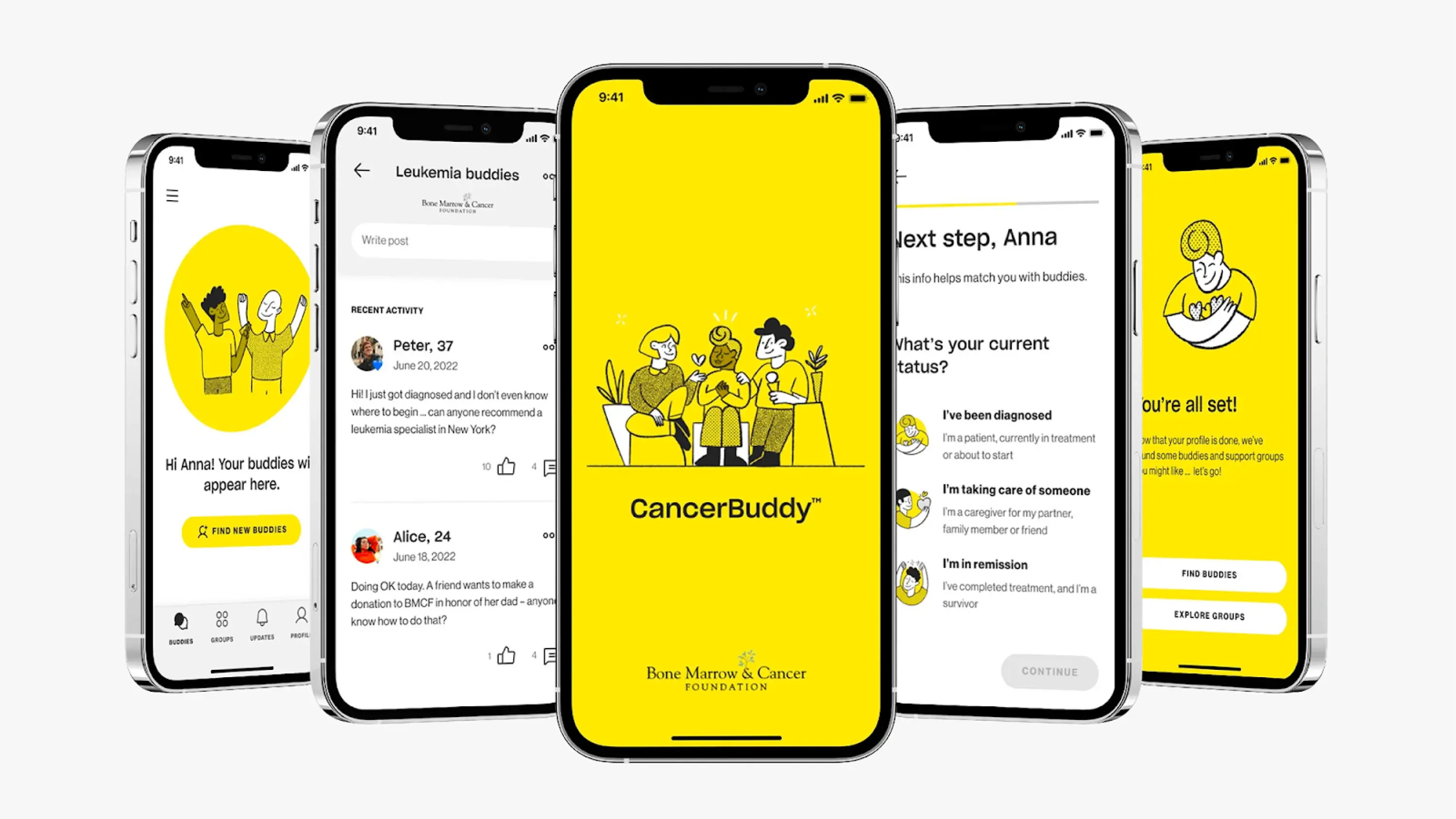
Why choose them
While frog doesn’t rely on ratings platforms, their work speaks through an impressive client list and a proven track record. The team has designed experiences used by millions and delivered projects that redefine digital ecosystems at scale.

Strong points
✔️ Robust design research and strategy foundation: deep experience framing complex problems and grounding decisions in research rather than assumptions.
✔️ Enterprise transformation experience: proven ability to support large organizations through wide-ranging change, not just isolated redesigns.
✔️ Global cross-functional teams: access to diverse expertise across regions, disciplines, and industries.
Things to consider
– High cost threshold: pricing is typically geared toward large enterprises, not startups or small teams.
– Longer timelines: large-scale collaboration and stakeholder alignment can extend project duration.
8. Fantasy — high-end digital experiences with ROI storytelling

Fantasy is a boutique design studio best known for creating forward-thinking digital experiences with a strong visual edge. From breathing AI innovation into platforms to launching flagship UX and stunning brand transformations, Fantasy knows its way around visual storytelling that captures attention and earns lasting mindshare. Their experience designing high-engagement products at scale translates well to the competitive consumer healthcare space, where standing out is key.
Overview:
- Founded: 1999
- Team size: 520+ specialists
- Pricing: $150-$249/hr, $50,000+ min project size
- Collaboration style : structured, iterative delivery with close client involvement throughout the process.
- Notable healthcare projects: 23andMe, Abbott Healthcare, Pfizer Viagra
Brief portfolio overview


Why choose them
Although Fantasy doesn’t rely on design directories, they’ve designed UX for multiple household names and built a solid reputation for setting a high bar for how digital experiences look and feel.

Strong points
✔️High visual polish: known for refined, visually striking interfaces that help products stand out.
✔️ Strong creative vision: excels at shaping product identity and experience direction, especially in early concept and redesign phases.
✔️ Engagement-driven design: designs experiences that capture attention, support brand recognition, and encourage repeat use.
Things to consider
– Visual storytelling emphasis: often heavy on visual design, with lighter in-depth UX research
– Less suited for complex B2B tools: not the best fit for functional, data-heavy B2B SaaS workflows
– Premium pricing: best aligned with well-funded teams or brands prioritizing experience quality over cost efficiency.
9. Phenomenon Studio — strategy-led digital health builds

Phenomenon Studio is a full-service design and development agency known for business-focused digital products with a stunning visual appeal. Their work spans a focused set of industries, including healthcare, where they help startups and SMEs design and scale impactful products. With multiple projects in regulated contexts, they know the nuances essential to making compliance and UX go hand in hand.
Overview:
- Founded: 2019
- Team size: 75+ specialists
- Pricing: $50 - $99/hr, min project size $10k
- Collaboration style: remote, PM-led, Figma-based with weekly reviews
- Notable healthcare projects: Zest, Medicare, Glume
Brief portfolio overview


Phenomenon Studio has a 5-star Clutch rating across 50+ reviews, with clients mentioning their responsiveness, high-quality work, and speedy delivery.

Reviewers also mention their passion for testing new ideas and technical proficiency to ship products confidently.

Why choose them
If you’re looking for a high-end UI paired with a reliable technical execution, Phenomenon Studio is your go-to choice. Backed by a decent grasp of UX principles, they deliver everything from product and website design to brand identity and viral social media assets, helping fast-moving teams launch actionable digital experiences.
Strong points
✔️ High-quality UI and branding execution: delivers polished interfaces and cohesive visual systems that elevate product perception.
✔️ Design and development in one team: close collaboration between designers and engineers helps reduce handoff friction and speed up delivery.
✔️ Innovative fast builds: expect flexible open-minded setup perfect for MVPs, tight timelines, and rapid-launch projects.
Weak points
– Post-launch support: some clients wished for more extended post-launch support for extra confidence
– Time zone differences: time zone delays may add some friction to fast-turn design feedback cycles.
10. Guidea — DTx / regulated experiences, deep women’s health expertise

Guidea is a savvy product-minded design agency working with multiple Fortune 100 companies across healthcare, fintech, and more. With a strong focus on healthcare, they drive design innovation for leading healthcare organizations in areas of behavioral health, AI, smart automation, and femtech. They boast an incredibly vast portfolio spanning healthcare digital platforms, narrow clinician tools, and regulated medical devices.
Overview:
- Founded: 2005
- Team size: 10+ specialists
- Pricing: $150-199/hr, min project size $50k+
- Collaboration style: in-house style, a dedicated design director and researcher with deep domain expertise
- Notable healthcare clients: BrightInsight, Welldoc, Cognoa, Somryst

Guidea holds a straight 5.0-star rating on Clutch, and although they have fewer reviews than larger orgs, the praise is consistent: the depth of niche knowledge, strategic decision making and commitment to excellence are among key remarks.

The team has outstanding proficiency in solving niche challenges and adapt to evolving needs with good precision.

Why choose them
Guidea blends impeccable design with strong data-driven research, making them a perfect go-to choice for orgs that are dealing with complex, niche challenges in regulated healthcare spaces. Being a women-owned, women-led company, they strive to foster innovation in the area of women’s health and health equity, which also makes them an ideal fit for femtech.
Strong points
✔️Unparalleled domain expertise: confidently close gaps in niche healthcare areas and speed up collaboration.
✔️ Data-driven execution: rigorous research and testing directly shape design decisions.
Weak points
– Higher price tag: their niche expertise comes at a premium pricing which may not fit budget-conscious teams.
– Frequent iterations: projects often involve multiple research and design rounds, which can feel intense for some teams
Comparison table: best healthcare UX & design agencies (2026)
Below is a side-by-side comparison of the curated healthcare UX and web design agencies featured in this guide, organized by company type fit, pricing signals, ratings, and core service focus.
Pricing and engagement models in healthcare design
Once you’re comparing shortlisted agencies, pricing and engagement structure naturally move to the foreground.
There isn’t one “standard” way healthcare design projects are priced. Each agency structures collaboration differently — some prioritize predictability, others flexibility, and some tailor scope entirely around the complexity of the product.
Healthcare products often involve layered requirements — regulatory review, multiple stakeholders, integration constraints, and complex workflows. Depending on how much of that is in scope, pricing can vary significantly.
Understanding the engagement model behind a proposal makes it easier to interpret the number attached to it.
What actually impacts cost in healthcare design projects
Healthcare design doesn’t cost more simply because it’s “healthcare.” Costs tend to shift based on the level of complexity, coordination, and validation required.
A few factors consistently influence scope and pricing:
- Compliance and documentation depth
In regulated environments, design decisions may need to be documented more thoroughly. That doesn’t always mean more screens — but it can mean clearer rationale, traceability, and alignment with legal or clinical stakeholders. When documentation and review cycles are involved, timelines can extend.
- Research and user recruitment
Recruiting clinicians, administrators, or specific patient groups is often more complex than recruiting general consumer users. Scheduling constraints, approvals, and compensation structures can increase both time and cost.
- Workflow complexity
Healthcare products frequently serve multiple roles (e.g., clinicians, nurses, admins, patients) within one system. Designing role-based access, dense data views, and safe interactions across these roles adds layers of UX consideration that go beyond surface-level design.
- Integration and system constraints
Many healthcare tools connect to EHRs, internal databases, or legacy systems. Even if development is handled separately, UX decisions often depend on technical feasibility and integration realities, which can influence iteration cycles.
- Stakeholder layers
Enterprise healthcare environments often involve multiple decision-makers — product, clinical, compliance, IT, and leadership. Alignment across these groups can add review rounds and structured checkpoints.
How to think about this when budgeting
Not every healthcare project includes all of these factors. But the more of them that apply, the more likely scope, timeline, and pricing will adjust accordingly.
That’s why comparing price alone rarely tells the full story — the context behind the scope matters just as much as the number attached to it.
How to narrow down the agencies above (fast)
The agencies listed above all work in healthcare and bring relevant experience to the table. Where they tend to differ is not in capability, but in the kinds of problems they’re most often asked to solve.

In practice, healthcare design is used for different primary goals. Some teams focus on building trust and improving patient acquisition; others work to increase product adoption and workflow efficiency. In some cases, the priority is creating a strong brand that consistently carries into the product experience.
Most healthcare products touch more than one of these areas. Many agencies operate across all of them. The challenge is not choosing the right category, but understanding which goal matters most right now, so you can interpret agency strengths and case studies with the right context.
The sections below outline a few common starting points to help you do exactly that.
1. Patient acquisition and trust
If your main challenge is getting users to convert, trust your product, or engage confidently, design work often centers around clarity, messaging, and credibility.
This typically shows up in:
- healthcare websites and landing pages
- onboarding and first-use experiences
- content-heavy flows where trust and comprehension matter
A medical website design agency that emphasizes UX writing, CRO thinking, and visual clarity can be especially helpful here. Others may still handle this well, but might approach it from a more product- or system-driven angle.
The key question to ask is not “can they design a website?” but “how do they build trust through UX?”
2. Product adoption and workflow efficiency
When adoption, usability, or internal efficiency is the bottleneck, the focus usually shifts to how the product works day to day.
This is common for:
- portals, dashboards, and EHR-adjacent tools
- telehealth platforms
- data-heavy or role-based systems
Here, strong agencies tend to show experience with complex workflows, dense information, and iterative improvement over time. Some teams lead with research and validation; others with fast iteration and close collaboration.
Rather than looking for a single “right” approach, it helps to understand how each agency handles complexity and what they prioritize when trade-offs arise.
3. Brand-led experiences that carry into the product
In some cases, the brand itself is a competitive advantage — and it needs to carry consistently from marketing into the product.
This often applies when:
- multiple touchpoints need to feel cohesive
- visual differentiation matters in a crowded market
- the product experience reinforces brand positioning
Some agencies naturally lean toward brand systems, visual language, and cohesive UI, while others approach branding as a supporting layer. Both approaches can succeed — the difference lies in how central brand thinking is to the overall design development.
A useful question here is: how do they connect brand decisions to real product UX?
How it all shows up in case studies
The underlying emphasis points outlined above aren’t always spelled out directly in case studies. Many portfolios can stay intentionally high-level, often due to confidentiality constraints or the need to simplify complex products for public presentation.
What matters is which patterns are reflected in the design decisions themselves. Instead of focusing only on polished screens, look at how flows are structured, how complexity is handled, and how the experience supports trust, clarity, and confident use over time.
For example, intuitive permissions, thoughtful onboarding, clear information hierarchy, or restrained use of visual emphasis can all signal how a team balances usability, safety, and business goals — even when those considerations aren’t explicitly described.
Seen this way, the signals above become a way to interpret real work more holistically, helping you understand how an agency approaches healthcare design in practice rather than judging individual features in isolation.
Where healthcare product goals ultimately converge
Whether your priority is patient acquisition, product adoption, brand positioning, or regulatory readiness, all of these goals eventually meet in the same place: the product experience itself.
In healthcare, UX is not a secondary layer that supports strategy — it is the mechanism through which strategy becomes real. Trust is built (or lost) through onboarding clarity and information hierarchy. Adoption rises or stalls based on workflow efficiency. Brand credibility is reinforced — or undermined — through interface consistency. Even compliance ultimately lives inside interaction design.
That’s why healthcare UX carries more weight than it might in less regulated industries. It isn’t just about making something usable or visually polished. It’s about simplifying responsibly within strict boundaries — balancing clarity with safety, efficiency with oversight, and accessibility with precision.
Regardless of which medical design firm you choose, any strong healthcare design consultant must consistently handle this tension. Below are three core responsibilities that shape mature healthcare UX in practice.
1. Simplifying within strict compliance boundaries
Healthcare products operate inside non-negotiable regulatory and privacy constraints. Consent requirements, role-based permissions, audit trails, data exposure rules, and security controls are built into the system from day one.
Strong healthcare UX doesn’t try to remove these layers. It integrates them in ways that improve usability while reducing risk. The goal isn’t aggressive simplification — it’s making complex requirements feel manageable without weakening safeguards.
In practice, that balance often shows up in details such as:
- Role-based access clarity — clearly signaling who can see or edit what, so users don’t hesitate or accidentally overstep permissions.
- Consent flows that preserve completion — meeting legal requirements without overwhelming end users or disrupting progress.
- PHI-safe notifications and screen-sharing states — anticipating moments where sensitive information could be exposed and handling them thoughtfully.
- Session timeouts that respect clinician workflows — enforcing security standards without interrupting critical tasks at the worst possible moment.
- Audit trail visibility without visual overload — maintaining accountability while keeping the interface focused and usable.
The key moment here is that usability and risk mitigation aren’t competing forces. And if handled well, they reinforce each other — protecting users while keeping the product efficient and clear.
2. Designing for real-world clinical and operational pressure
Healthcare systems are rarely used in calm, distraction-free environments. Clinicians are interrupted mid-task in hospital settings. Administrators juggle multiple responsibilities. Patients may log in briefly, leave, and return later.
Strong healthcare UX accounts for this operational reality rather than assuming ideal conditions.
In practice, that often means designing for:
- Interruptions, multitasking, and short sessions — ensuring users can pause and resume work without losing progress or context.
- Dense data and frequent context switching — structuring information so it remains scannable and cognitively manageable, even when screens carry clinical or operational complexity.
- “Glove-friendly” or constraint-aware interaction patterns (where relevant) — recognizing physical environments, device limitations, or usage conditions that affect precision and input behavior.
- Error prevention over error correction — building safeguards directly into flows so mistakes are less likely to occur in the first place, especially when time pressure is high.
And yes, it doesn’t always translate into the most visually minimal interface – and it shouldn’t. In healthcare, clarity, structure, and safety go over visual minimalism.
And when done well, it supports reliability in the background, easing cognitive load and lowering the risk of avoidable errors when attention is split.
3. Designing for accessibility and health literacy
Healthcare products serve people with different literacy levels, cognitive loads, physical abilities, and emotional states. Accessibility in UX isn’t a secondary requirement — it directly shapes whether a product feels usable, safe, and trustworthy in real life.
In strong healthcare UX, this typically means:
- Treating WCAG as a baseline, not the ceiling — recognizing that compliance alone isn’t enough and designing intentionally for older adults, users with limited health literacy, and varying levels of digital familiarity.
- Using plain language and empathetic UX writing — reducing medical jargon, clarifying next steps, and guiding users in ways that lower anxiety and improve comprehension.
- Applying progressive disclosure thoughtfully — structuring complex medical or procedural information in layers so users aren’t overwhelmed but can access depth when needed.
- Prioritizing color, contrast, and data visualization legibility — ensuring critical information remains readable, distinguishable, and interpretable in high-stakes or time-sensitive scenarios.
Overall, good accessibility doesn’t oversimplify healthcare products – it just makes them clearer and more reliable within necessary constraints.
A practical checklist for teams close to the decision
At this stage you’re perhaps, no longer comparing portfolios. You’re likely speaking with two or three clinic design agencies, reviewing proposals, clarifying scope, and trying to sense which partnership will actually work in practice.
This is where many healthcare teams may rush — not because they lack information, but because everything looks equally solid on the surface.
The checklist below isn’t about catching red flags. It’s about reducing avoidable friction later.
1. Is the working setup and scope clearly defined?
Before evaluating design thinking, make sure the collaboration structure itself is clear.
Many healthcare projects don’t struggle because of design quality — they struggle because expectations weren’t aligned early.
Clarify upfront:
- Who will work with you day to day — and how continuity is handled if someone transitions off the project.
- How responsibilities are divided within their team — who leads research, who owns UX writing, who coordinates implementation.
- How feedback flows between your teams and theirs — who consolidates input, and how decisions are finalized.
- How consistency is maintained across designers — especially in longer or multi-stream engagements.
- What level of iteration is built into the engagement — how many rounds are expected, and how refinements are structured.
- How additional requests are handled and priced — and at what point something becomes a new scope.
Healthcare work rarely unfolds in a perfectly linear way. What matters isn’t rigid predictability — it’s having a shared understanding of how adjustments are handled.
Clarity at this stage prevents friction later.
2. Go beyond what you’ve already seen
By now, you’ve reviewed the portfolios. You know the quality level. The shortlisted agencies look competent.
The more useful signal at this stage isn’t what they show — it’s how they explain it.
In conversations and proposals, pay attention to:
- How they describe trade-offs — usability vs compliance, speed vs validation, clarity vs information density.
- How they talk about research — including how healthcare users are recruited, how insights are synthesized, and how findings shape decisions.
How they explain iteration — what refinement looks like over time, and how feedback is incorporated - What happens after design delivery — especially around handoff, implementation, and collaboration with engineering.
- Whether they reference outcomes, not just deliverables — what changed, how it was measured, and what impact the work had.
At this stage, you’re not evaluating aesthetics. You’re assessing depth of thinking. In healthcare, that depth often determines whether the work holds up beyond the first release.
3. Is there clarity around what happens after launch?
Like any serious software product, healthcare platforms continue evolving after release. Once real users engage with the system, new signals emerge: friction points, workflow adjustments, and unexpected edge cases.
At this stage, clarify:
- Is there post-launch support?
- Will there be usability testing after release?
- How will performance or adoption metrics be tracked?
- Who owns iteration once real users engage?
In complex environments, what happens after release can determine success as much as the initial design practices.
4. Does the partnership feel workable — not just impressive?
Finally, ask yourself and discuss with stakeholders the simplest question: Can we realistically work with this medical design agency for the next 6–12 months?
Healthcare design involves layered input, evolving constraints, and continuous adjustment. A partnership that feels stable, transparent, and communicative is often more valuable than one that simply feels prestigious.
And remember – no agency can eliminate uncertainty completely. But clarity in structure, expectations, and communication significantly reduces avoidable risk.
Turning your shortlist into a decision
The agencies listed above are all credible healthcare design providers. The right choice comes down to fit — not only in strengths and working style, but also in budget, scope, timeline, and how you prefer to collaborate.
As you move forward:
- Shortlist 2–3 teams that align with your current priorities and constraints.
- Look at pricing structure, engagement model, and communication style — not just portfolio polish.
- Clarify scope and expectations early to avoid friction later.
If you’re planning a redesign, starting with a focused UX audit can help you define what truly needs attention before committing to a larger engagement.
And before entering a long-term contract, consider beginning with a short trial. It’s one of the simplest ways to test collaboration, quality, and process in real conditions.
At Eleken, we offer a free 3-day trial so you can test the fit and to execution quality in a real working setup with zero risk and commitment.
Because guesswork is never a safe strategy – especially in healthcare. But taking a thoughtful first step surely brings structure and confidence to everything that follows.