

Customer acquisition isn't your biggest challenge if you're building a SaaS product. Retention is. Most churn doesn’t happen because users hate your product. It happens because they don’t know how to succeed with it.
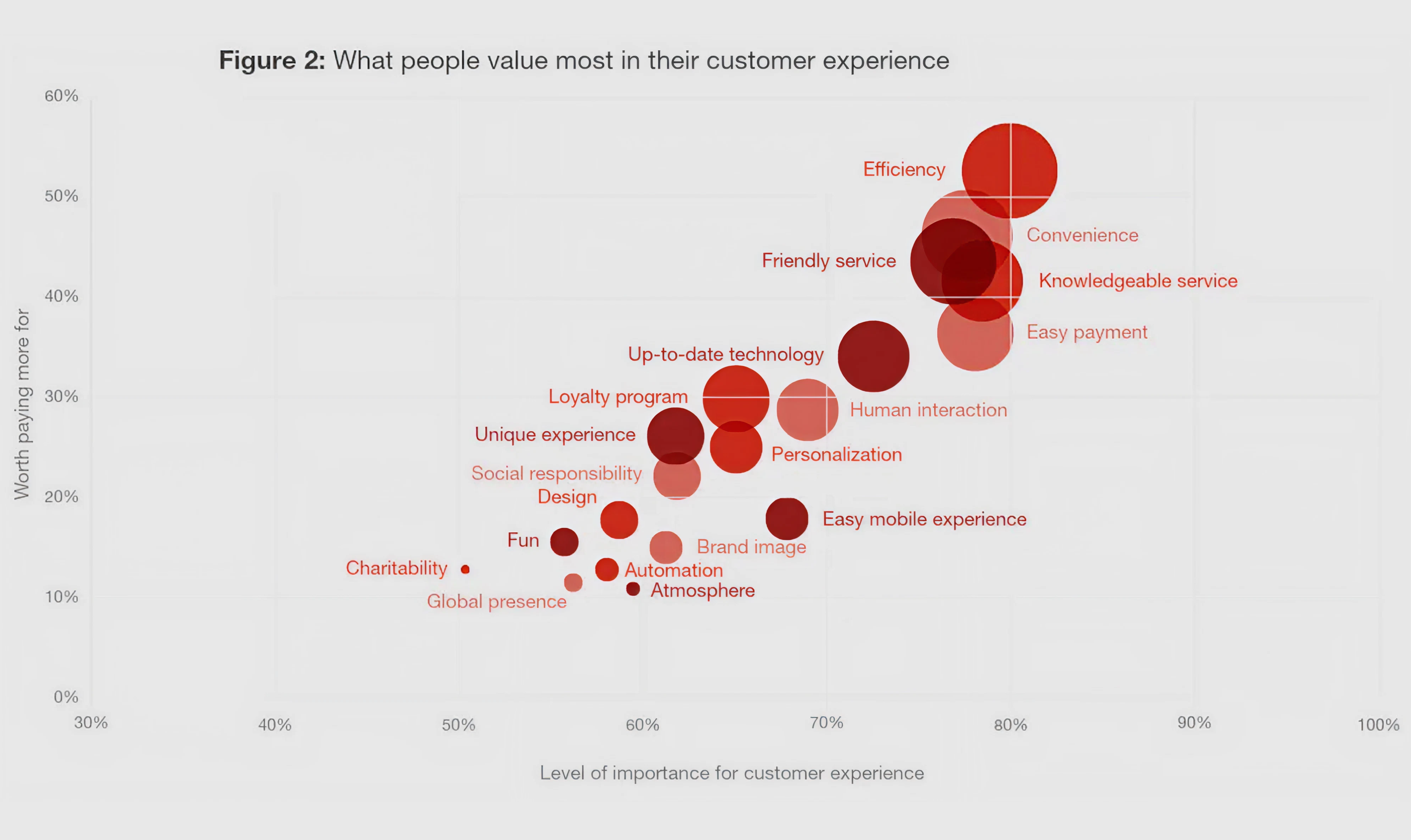
PwC's report found that 80% of customers expect speed, clarity, and a smooth experience. Design and automation help, but they mean nothing without the right support at the right time.
That’s what a customer success (CS) plan is for. It's not some bloated PDF with KPIs nobody checks. It's a practical tool to keep your customers winning and your team aligned.
We at Eleken created a template that actually works to help your CS team (or… you, if you are the CS team) drive adoption, retention, and growth without second-guessing your process.
Understanding customer success plans
Before diving into the template itself, let’s ensure we’re on the same page about what a customer success plan is and why it matters.
What is a customer success plan?
A customer success plan lays out where customers want to go, how your product helps them get there, and what you’ll both do along the way.
It’s not the same as customer service. The service is reactive: fixing bugs, answering tickets, or resetting passwords.
Success is proactive. It’s about ensuring customers get the outcomes they came for in the first place.
Let’s say your customer just bought a workflow automation tool. They don’t care about the tool. They care about saving 10 hours a week. A good success plan makes that clear and puts a structure in place to help them get there.
Customer success plan template
Here’s the template to get started.
Template to download.
Key components of a success plan
Every CS plan should be tailored to the customer, but most good ones include:
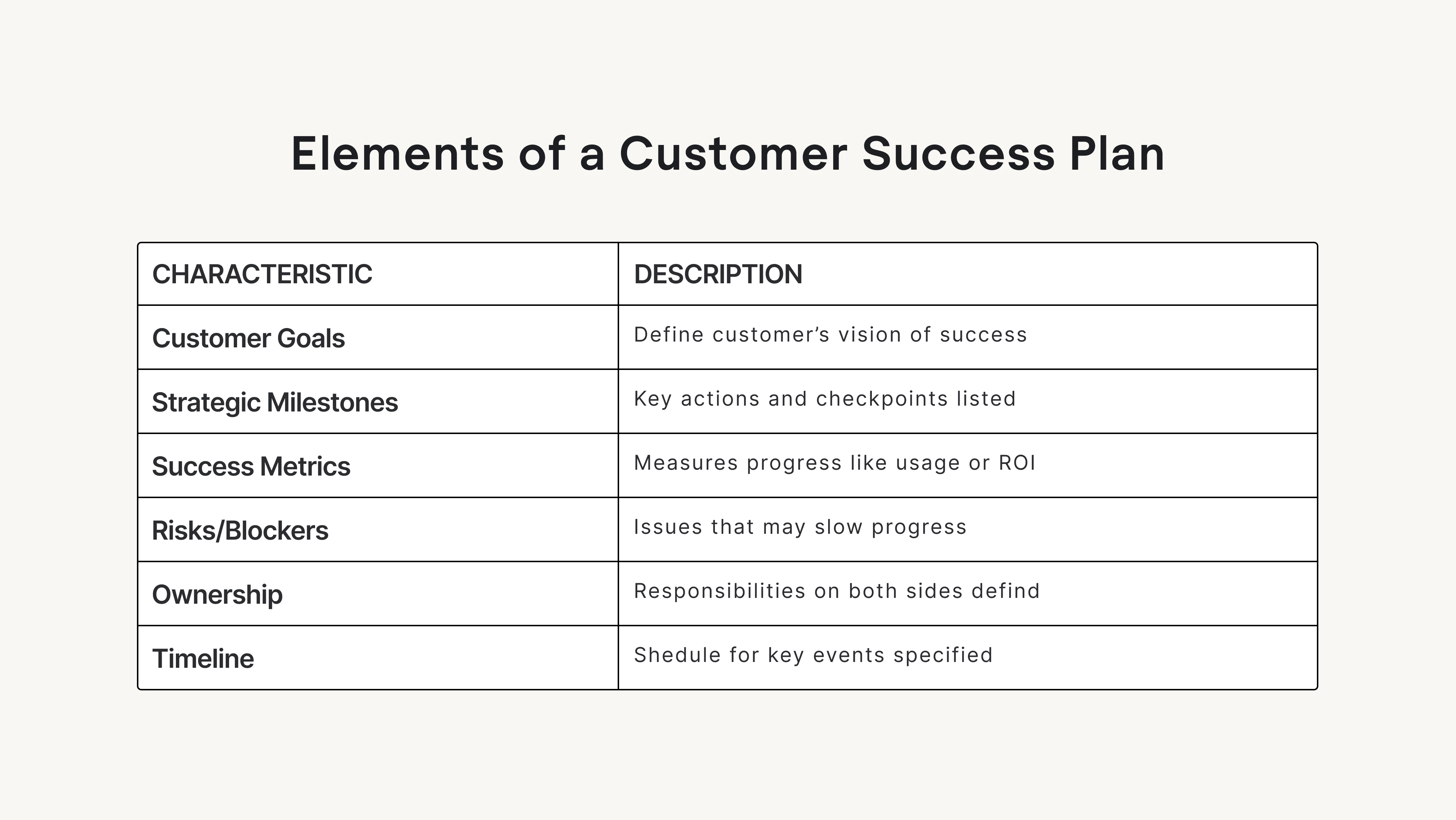
- Customer goals: What does success look like for them?
- Strategic milestones: Key actions and checkpoints toward that goal.
- Success metrics: How progress will be measured (usage, ROI, time saved, etc.).
- Risks or blockers: Known issues or concerns that could slow progress.
- Ownership: Who’s responsible for what (on both sides).
- Timeline: When key things should happen.
A customer success plan isn’t a 20-page doc nobody reads. It can be as simple as a shared Notion page or a basic SaaS dashboard, as long as it’s actionable, visible, and kept up to date.
So why bother creating one? Because winging it doesn’t scale.
Without a clear plan, you’re relying on individual team members to “just know” what each customer needs. That works usually right around the time your team starts growing.
A good success plan helps you:
- Keep everyone aligned.
- Reduce churn by showing customers you’re proactive.
- Spot red flags early, before they become churn risks.
- Smooth out the SaaS user onboarding process.
- Have meaningful QBR and renewal conversations.
Now that we agree it matters, let’s make it easy.
Introducing the template
We at Eleken made the customer success plan template simple and flexible, and built it specifically with SaaS in mind. Just the right fields to help you stay focused on what drives customer retention and growth.
Here’s what’s inside:
- An overview section to help you quickly understand each customer’s background.
- Space to define objectives based on what success means for them, not just for you.
- A place to outline solutions and how you’ll support their goals.
- A structured action plan with steps, owners, and deadlines.
- Sections for change management, implementation, and ongoing review.
You can use this customer success plan example in whatever tool works for your team: Notion, Google Docs, ClickUp, or even plain text. It’s copy-paste friendly and totally customizable.
We also recommend turning it into a live document you revisit often, not a dusty PDF you only open before renewal calls.
Detailed walkthrough of the template
Let’s break it down, step by step. This template is designed to create a shared customer success roadmap between you and your customer: transparent, collaborative, and focused on outcomes.
Overview
Start with the basics: company name, point of contact, team structure, product tier, start date, anything that gives you quick context.
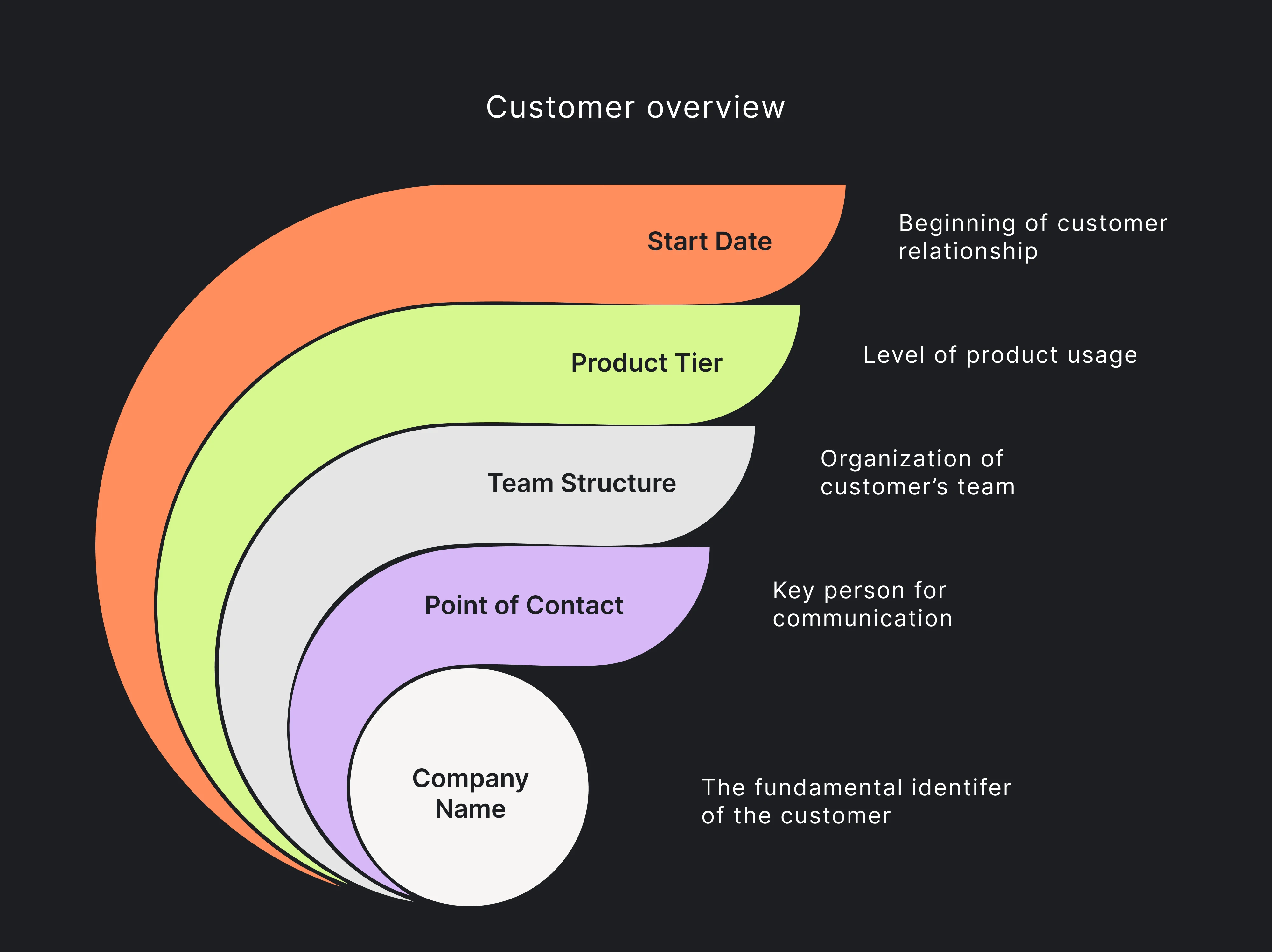
But don’t stop at surface-level info. This section should also answer:
- Why did they buy your product?
- What were they using before?
- Who’s your champion? Who’s the blocker?
- Any red flags already visible?
This part is your cheat sheet. When juggling 30 accounts and can’t remember who’s who, this is what saves you.
Objectives
Now let’s talk about what “success” actually means for this customer. Because if you don’t define it, neither of you will know when you’ve hit it.
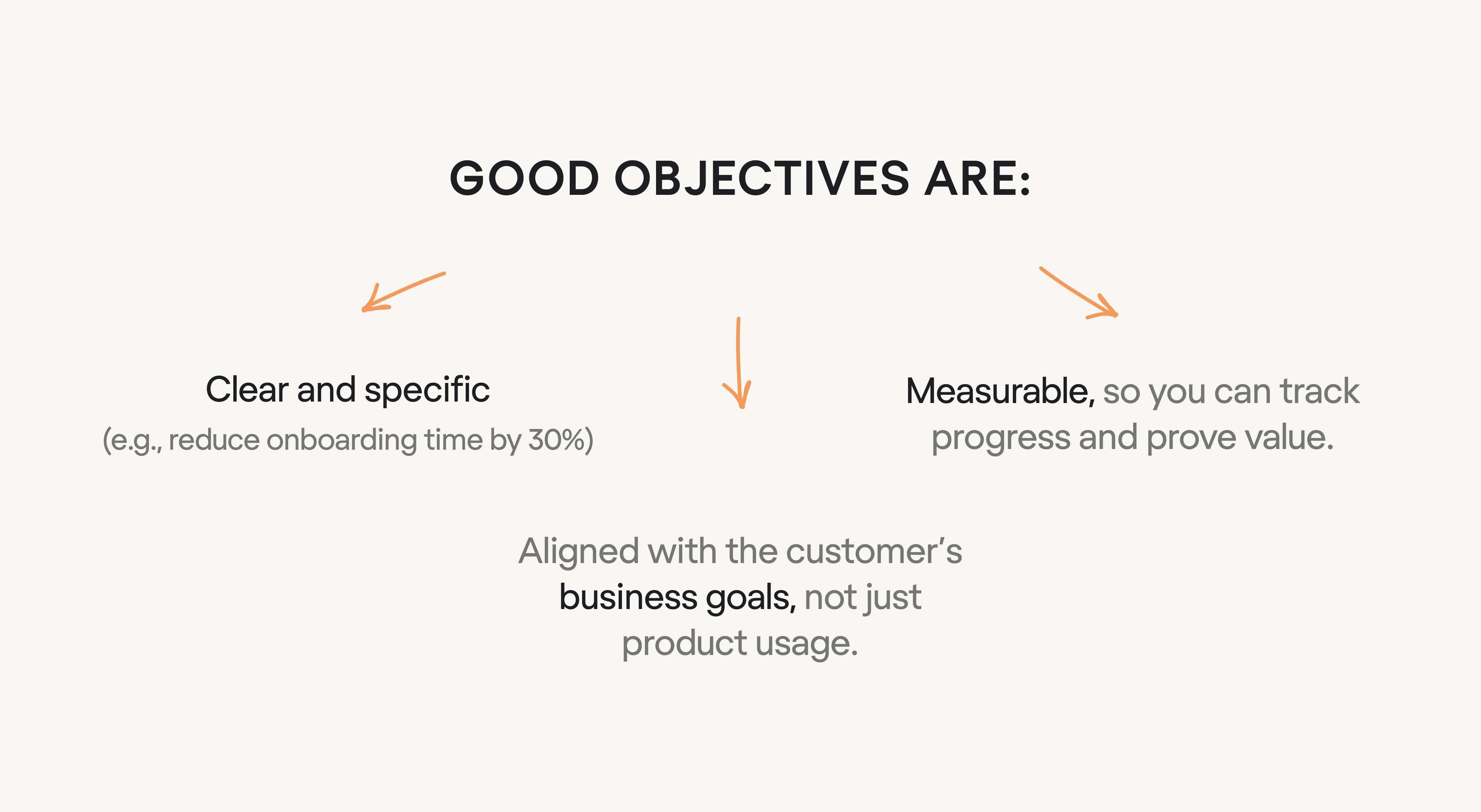
Good objectives are:
- Clear and specific (e.g., reduce onboarding time by 30%).
- Aligned with the customer’s business goals, not just product usage.
- Measurable, so you can track progress and prove value.
Here is an example: “The customer wants to use our tool to automate reporting and save 8 hours/week for the ops team.”
If you're not sure what the goal is, ask. Then, write it down and reach a mutual agreement. Otherwise, you’re both flying blind.
Solutions
This is where you connect the dots between the customer's goals and your product.
Ask yourself: What parts of our product will actually help them reach their objectives?Don't list every feature. Focus on the ones that matter for this customer.
You can also note any custom configurations, integrations, or design tweaks you plan to offer.
Below is an excerpt from the success plan example for reference:
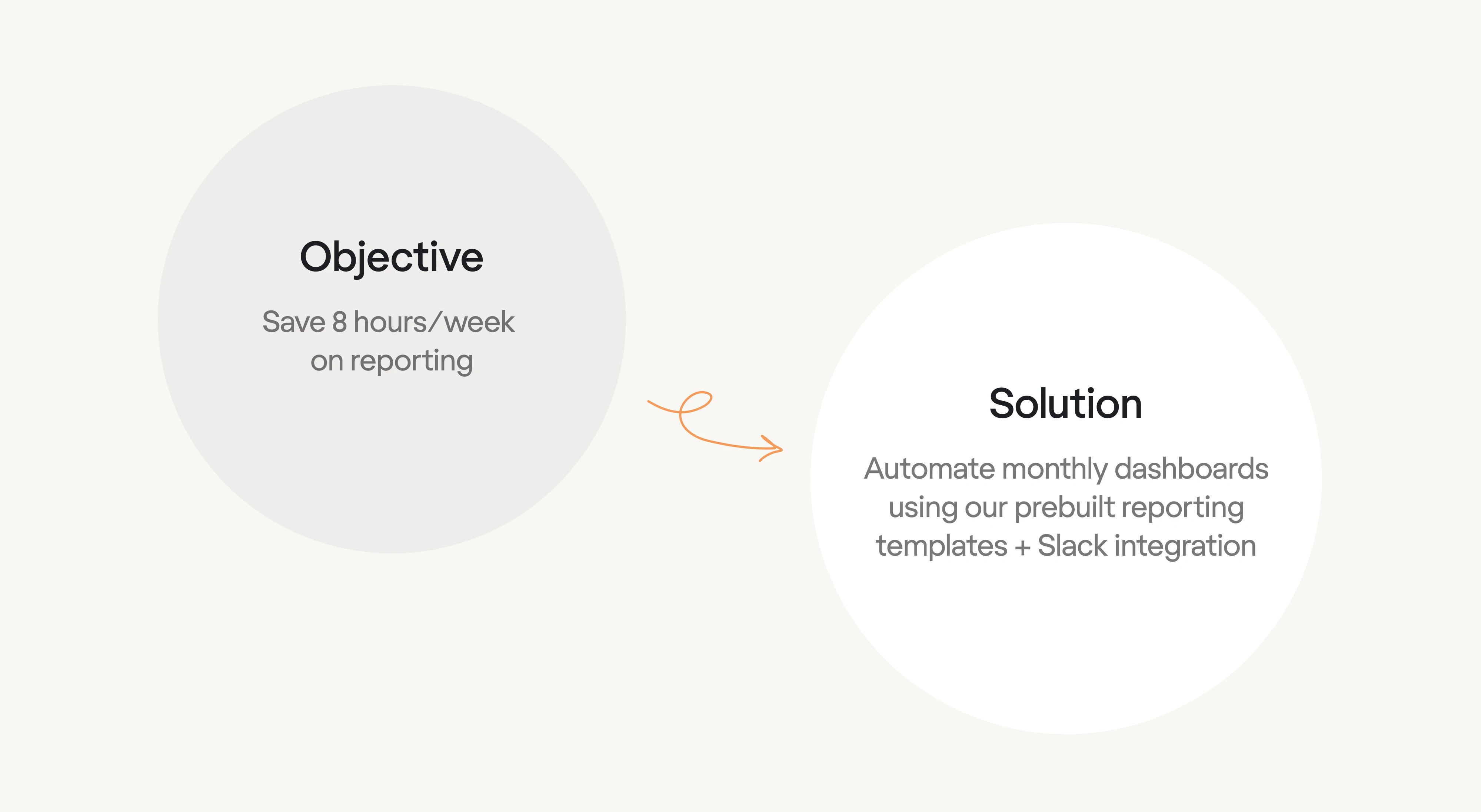
Your solution is the vehicle if your customer’s objective is a destination. Be specific. Be relevant. Don’t offer a rocket when all they need is a bicycle.
Action plan
Here’s where things get tactical. The action plan lays out:
- What needs to happen.
- Who’s doing it (you vs the customer).
- When it needs to be done.
This turns goals into execution; otherwise, they’ll just live in a slide deck until next quarter.
A basic plan might look like:

A good action plan is collaborative. Get buy-in, don’t just assign tasks. This is how you avoid ghosting and finger-pointing later on.
Change management
Even if your product solves a real pain point, change is still hard. About 50% of people resist it, ignore it, and sometimes sabotage it without meaning to.
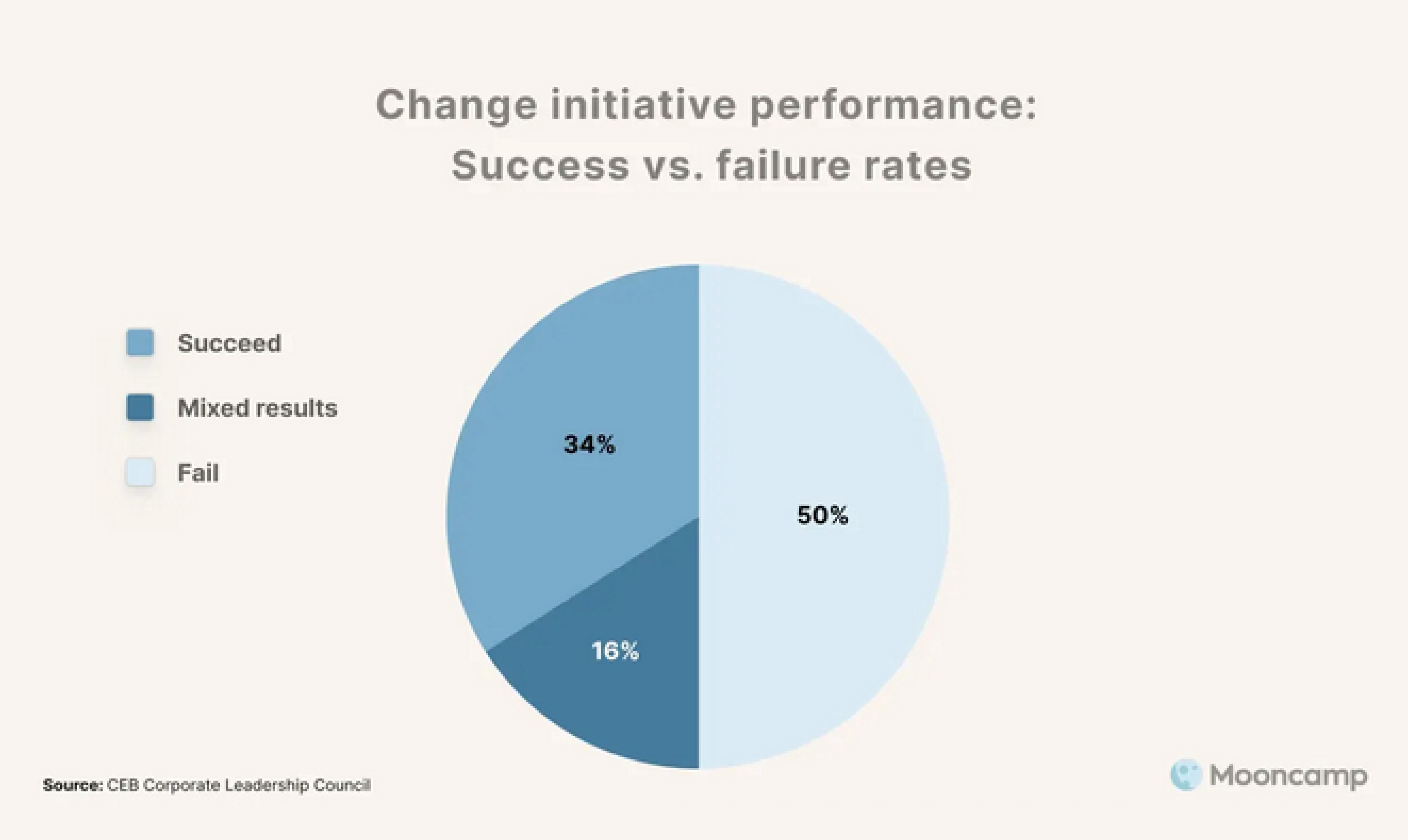
That’s why it’s smart to bake change management into your success plan.
Here’s what to cover:
- Key stakeholders: Who needs to be informed, trained, or reassured?
- Potential resistance: Where could things get stuck or pushed back?
- Communication plan: How will you keep everyone aligned?
For example, if a sales team is switching CRMs, the actual challenge isn’t the software. It’s the fact that reps have to relearn their workflow mid-quarter. Naming that upfront helps you plan for it and earn trust.
You don’t need a formal change strategy. Just show that you’re thinking ahead. That alone can prevent most surprises.
Implementation
This is where the plan gets real. You’ve defined goals, mapped out solutions, and assigned tasks; now it’s time for SaaS companies to actually do the thing.
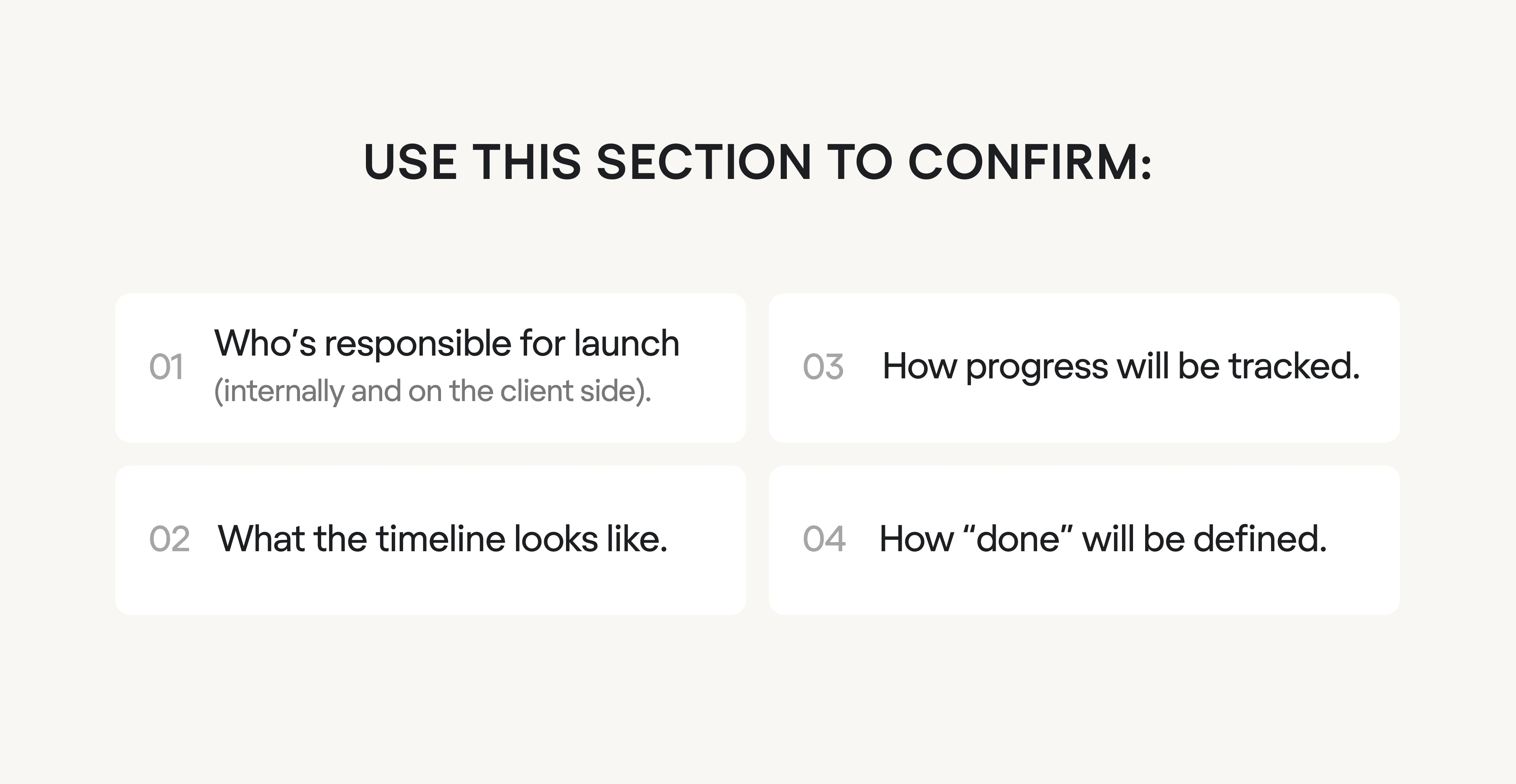
Use this section to confirm:
- Who’s responsible for launch (internally and on the client side).
- What the timeline looks like.
- How progress will be tracked.
- How “done” will be defined.
Tip: Keep implementation lightweight. No one wants another giant project plan. Instead, aim for just enough structure to move forward confidently.
Example:
“Implementation starts the week of July 1. The CS lead will check in every Friday until the dashboard is live and stakeholders are trained.”
Clear beats comprehensive here. The more friction you remove, the faster you get to value.
Review and optimization
Once the plan is in motion, don’t set it and forget it.
Use this section to outline how you’ll review progress, identify roadblocks, and adjust the plan as needed. It is your feedback loop that keeps everything honest.
At minimum, this section should include:
- Check-in frequency (weekly, bi-weekly, monthly).
- SaaS metric you'll review (goal progress, adoption rates, NPS, etc.).
- Next steps for optimization (feature changes, added support, new goals).
Example:
“Bi-weekly syncs to review dashboard usage and team feedback. If adoption stays low after 3 weeks, we’ll consider async training or adjusting dashboard format.”
This part shows the customer you’re in it with them, not just until launch, but as a long-term partner.
Metrics and evaluation
Tracking progress is about knowing what’s working, what’s not, and where to focus next.
Key metrics to track
Here are the core SaaS metrics we recommend including in your success plan; each tells part of the story:
- Net Promoter Score (NPS): Are customers likely to recommend you? It’s simple, powerful, and easy to benchmark.
- Customer Health Score: A composite measure of product usage, engagement, and support activity. Great for spotting churn risks early.
- SaaS Churn Rate: If people are leaving, why? Track both gross and net churn when possible. A churn rate calculator from Eleken can help you monitor this consistently across accounts.
- Customer Lifetime Value (CLTV): How much value is this customer bringing over time? Use LTV calculator SaaS tools to project long-term profitability.
- Customer Acquisition Cost (CAC): What does it cost to acquire a customer? Use a CAC calculator to assess efficiency and align the acquisition strategy with growth goals. Managing CAC SaaS effectively is key to scalable, sustainable growth.
- Product Adoption Metrics: Are they actually using the features tied to their goals?
You don’t need to track all of these for every customer. Start with the ones that make sense for your SaaS product, your team, and your current growth stage.
What “good” looks like
Benchmarks vary wildly by industry, but here are some general guideposts:
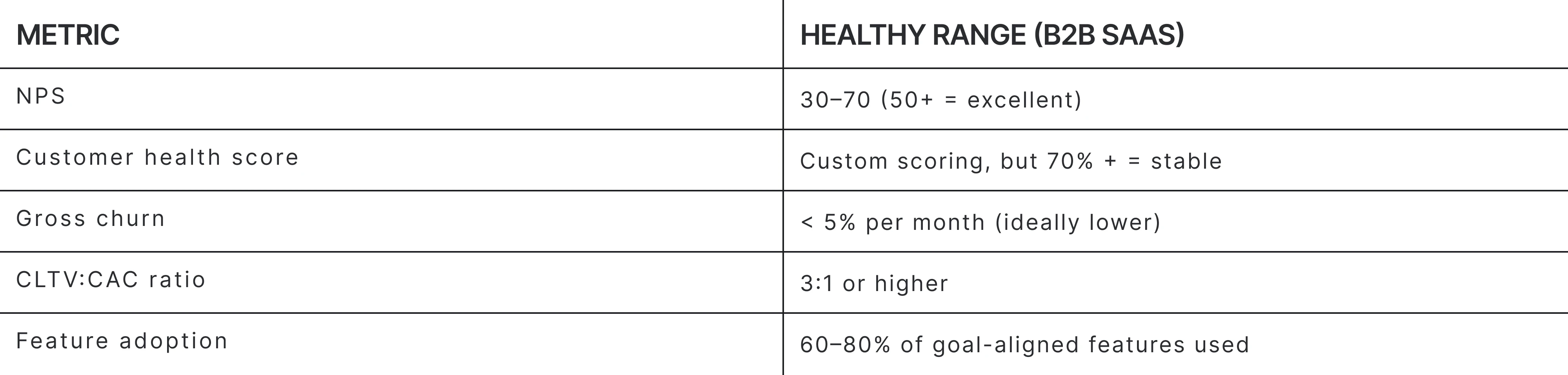
Don’t obsess over perfection. Focus on trends over time, and act when you see a dip.
How to use the data
Once you’ve got these metrics, make them actionable:
- Use health scores to trigger proactive outreach.
- Share NPS results in product meetings (yes, really).
- Review adoption trends to prioritize customer training or design changes.
- Use churn reasons to improve onboarding or messaging.
Metrics are your early warning system that tells you what your customer won’t always say out loud, but only if you’re listening.
Common challenges and solutions
Even with the best template, things won’t always go to plan. That’s normal. Here are a few common roadblocks you might hit and how to deal with them.
Challenge: Customers don’t engage with the plan
You’ve created a beautiful success plan. You’ve shared it. And then… crickets.
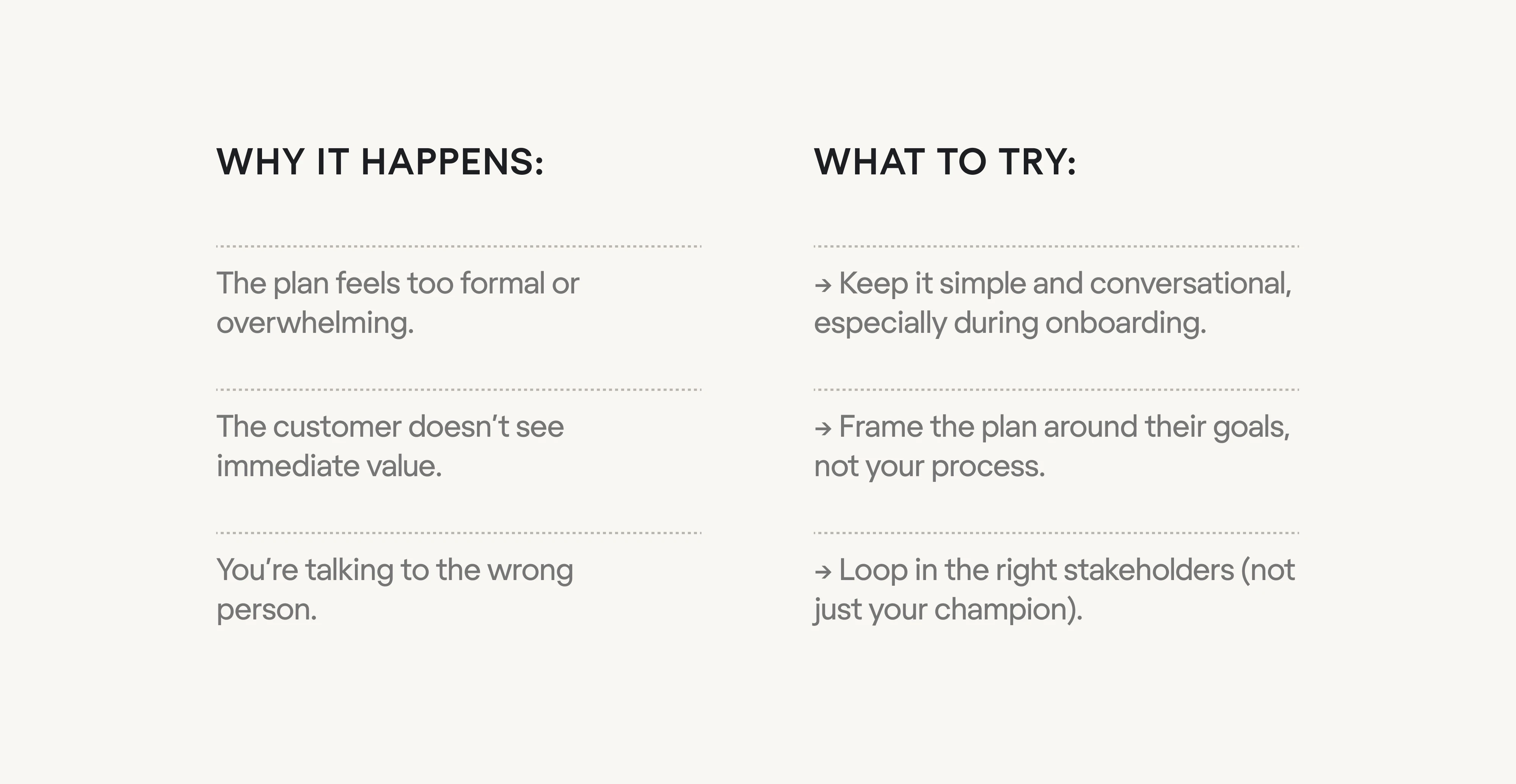
Sometimes, a quick Loom video walking through the plan can do wonders.
Challenge: The plan goes out of date
A quarter goes by. People change roles. Priorities shift. Suddenly, your success plan looks like a time capsule.
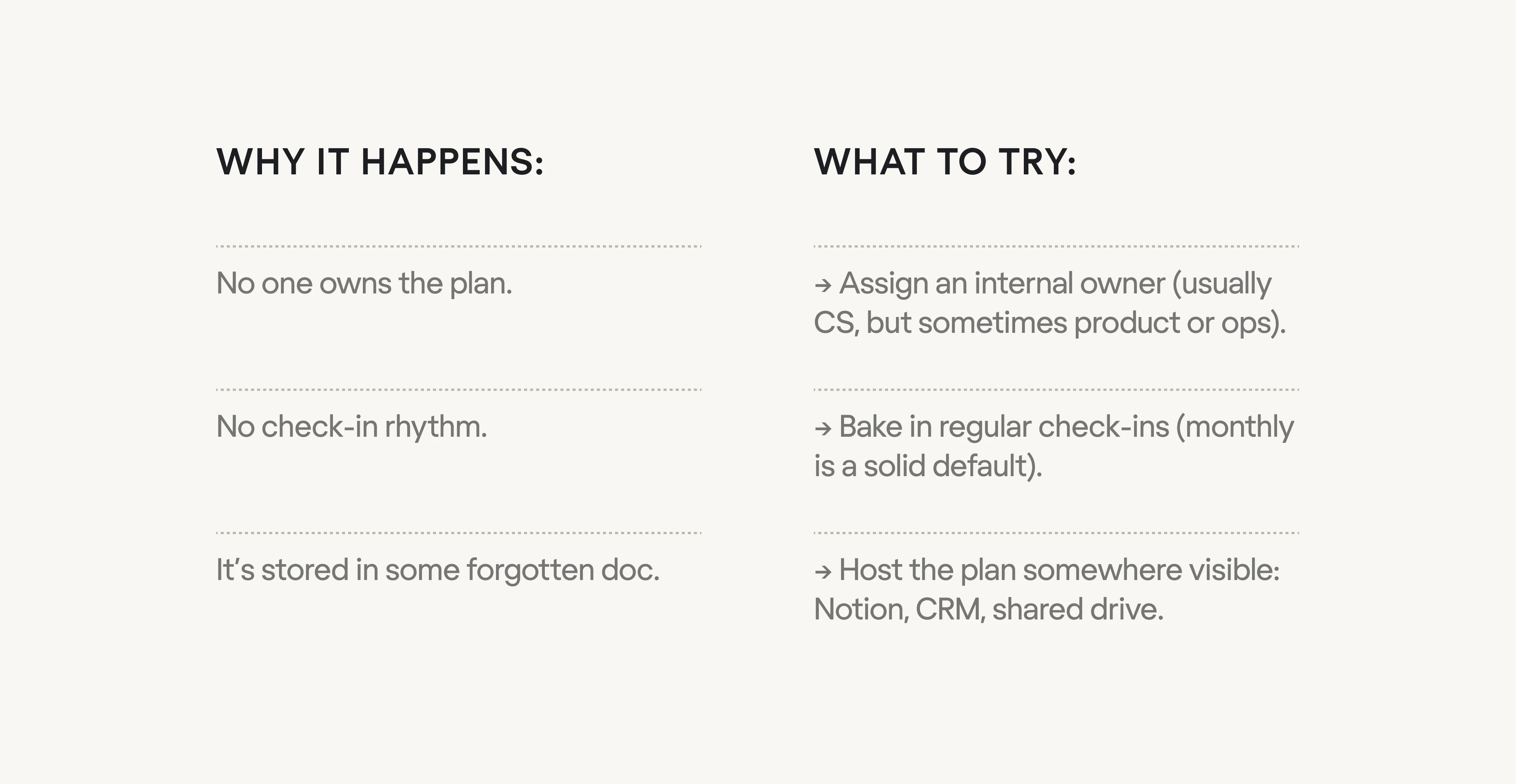
A good rule: if it’s not alive, it’s not useful.
Challenge: It feels like extra work
Customers and sometimes your team see the plan as more admin, not more value.
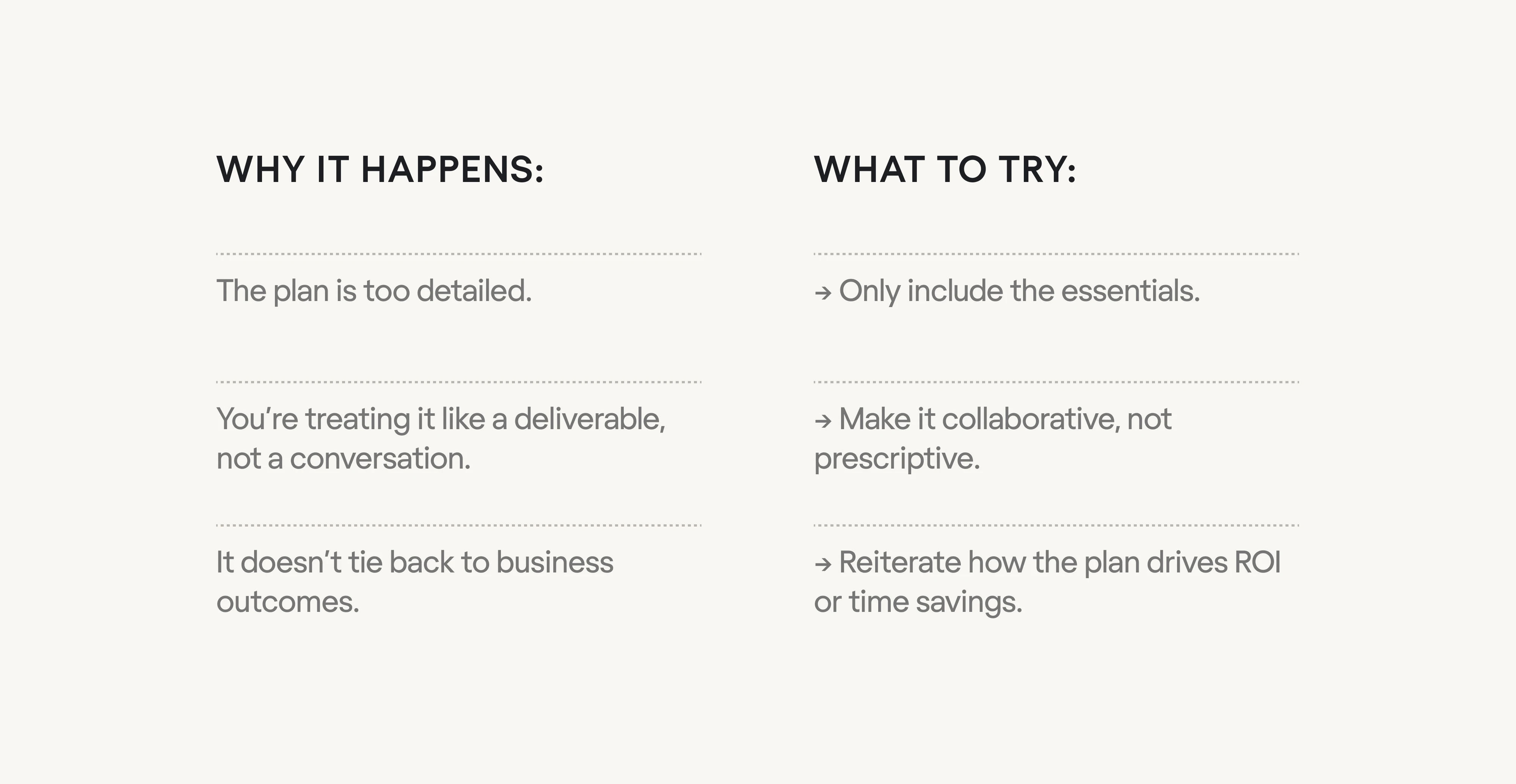
This isn’t school. You’re not handing in homework. You’re building a shared roadmap. Then you can naturally transition into your next section.
Keep It Moving
A SaaS customer success plan isn’t something you create, check off, and forget. It’s a living thing. Because customers change, their goals shift. Your product evolves. If the plan doesn’t keep up, it becomes clutter instead of value.
So ask questions. Not just in quarterly reviews, but in everyday chats:
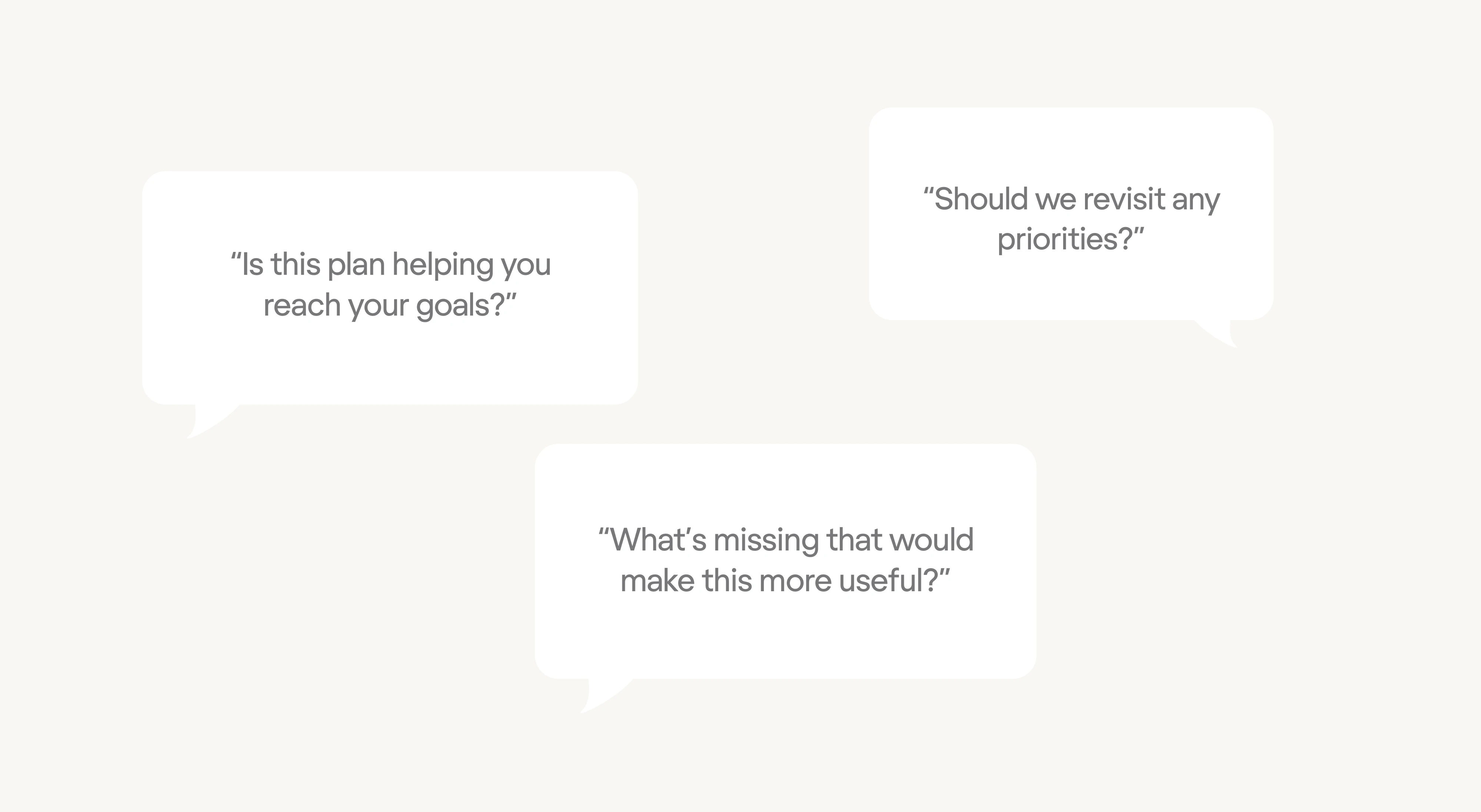
It doesn’t have to be formal. The best insights often come from casual, honest moments.
Also, check in with your internal team, like CSMs, designers, product folks, and anyone interacting with the customer. They’ll often spot friction you’ve missed.
When you get feedback, act on it. Then document what you changed and why. That way, the plan becomes a living artifact, not just a checklist.
Some things you might iterate:
- Goals if the customer’s business shifts.
- Milestones if timelines slip.
- Tools or processes, if adoption is slow.
Keep it lean. The goal should stay aligned as the relationship evolves.
Additional resources
Sometimes the best way to improve your own process is to see how others do it. There’s a growing number of CS communities where people share wins, fails, templates, and tools.
For example, Gain Grow Retain is probably the best-known CS community for B2B SaaS. It’s packed with thoughtful discussions and proven playbooks.
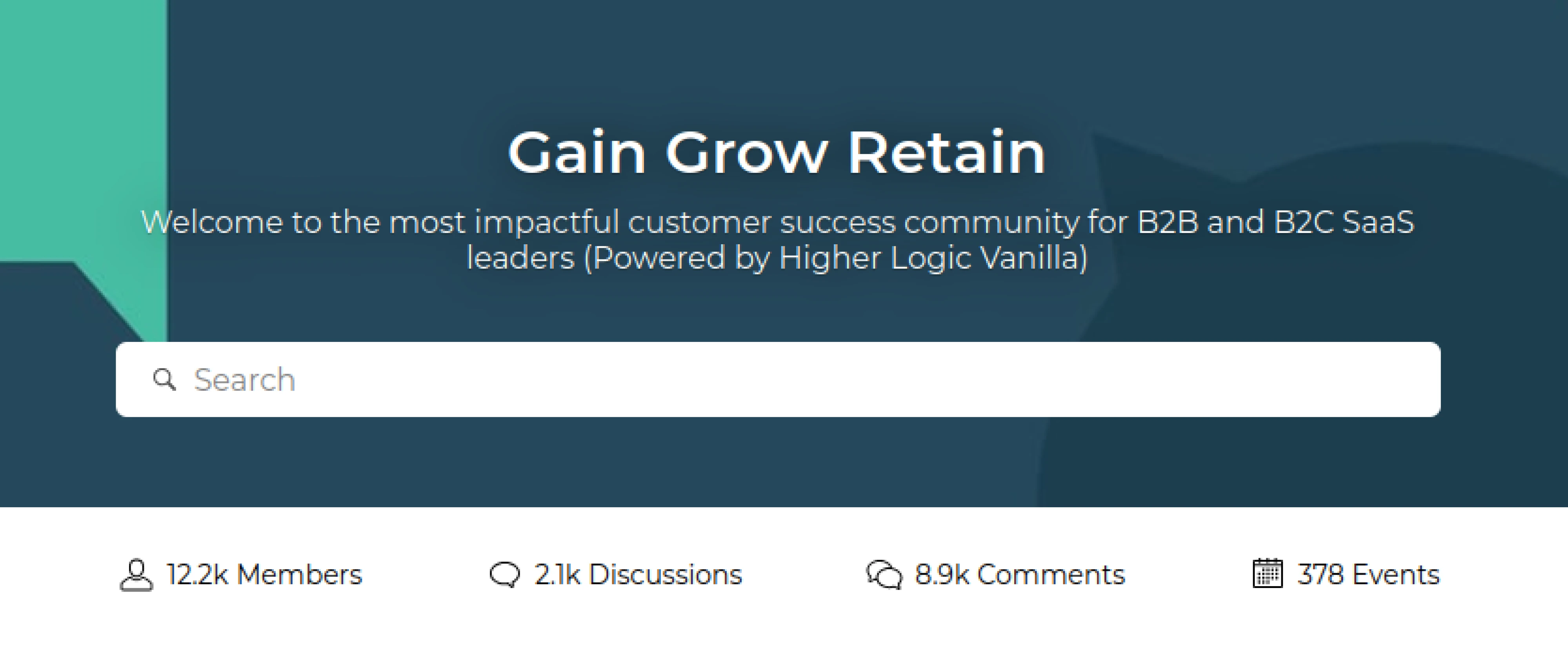
CS Insider is another gem. It is great for candid conversations and advice.

Even discussions on Reddit can surprise you. Don’t underestimate how useful it is to learn from folks in the trenches.
And if you want to dig even deeper, these reads are worth your time:
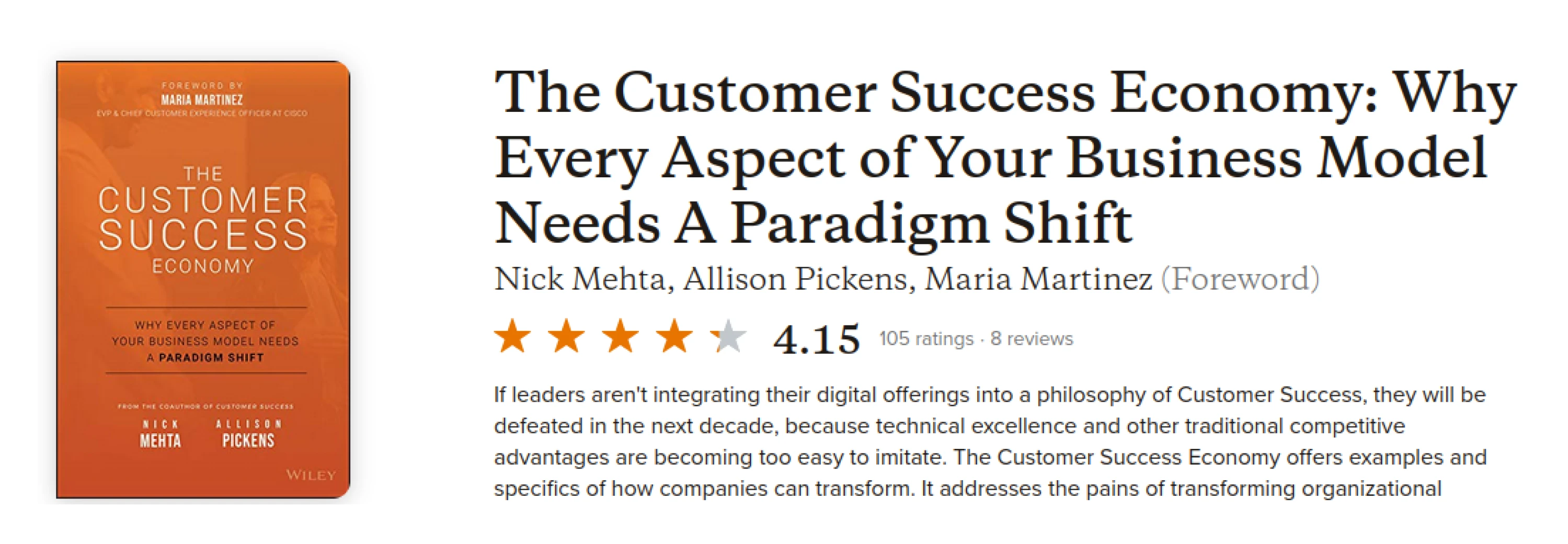
- The Customer Success Economy by Nick Mehta & Allison Pickens. Good mix of theory and tactics.
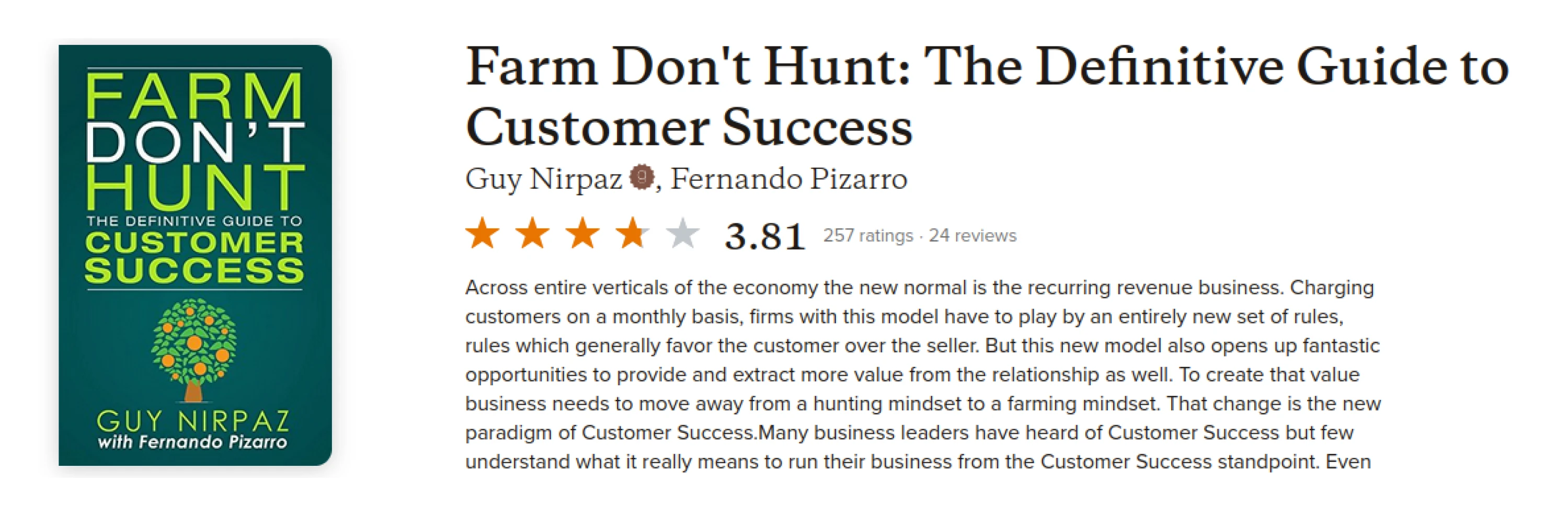
- Farm Don't Hunt by Guy Nirpaz. Short and actionable, especially for recurring revenue teams focused on SaaS profitability through long-term customer relationships..
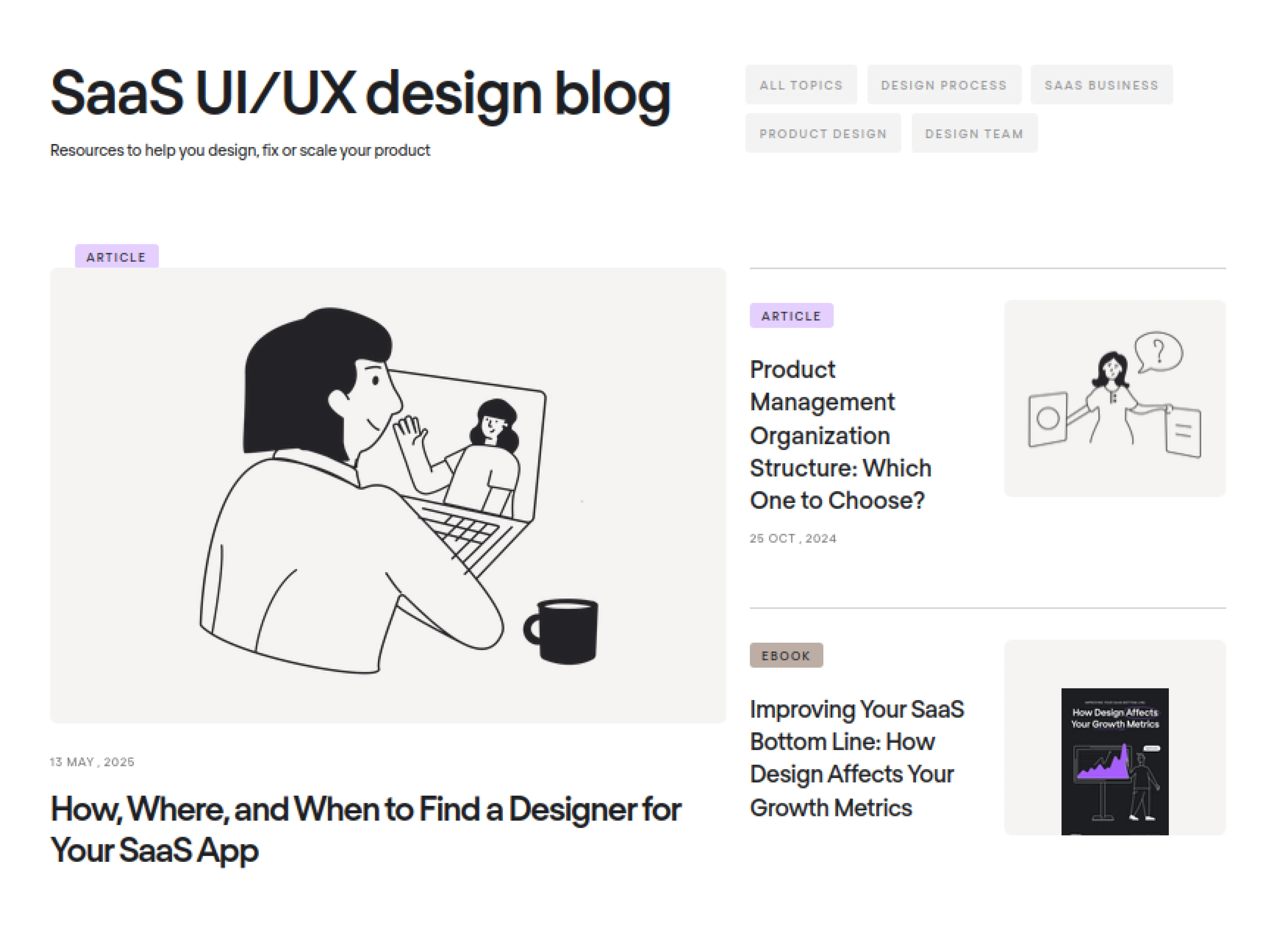
- Eleken blog: How to improve customer retention with UX design. Design-led look at retention strategy.
These will give you context and inspiration beyond just filling in templates.
Conclusion
A customer success plan is about alignment between you and your customer. Between your team and their outcomes. Between what’s promised and what’s delivered.
This template gives you a starting point. A way to structure conversations, track goals, and adapt over time. The goal isn’t to have the perfect plan. It’s to have a plan that actually gets used.
So go ahead:
- Download the success plan template.
- Fill it in with your next customer.
- Adjust it as you learn what works.
And when you’re stuck or unsure, reach out to us. We’re here to help.